





The demand for polyurethane foam continues to grow across industries such as mattresses, furniture, automotive, insulation, and packaging. Meeting this demand requires efficient production systems that can maintain consistent foam quality while supporting large manufacturing volumes. A Continuous Foaming Machine is an important solution for manufacturers looking to improve their production capabilities and streamline foam manufacturing operations.
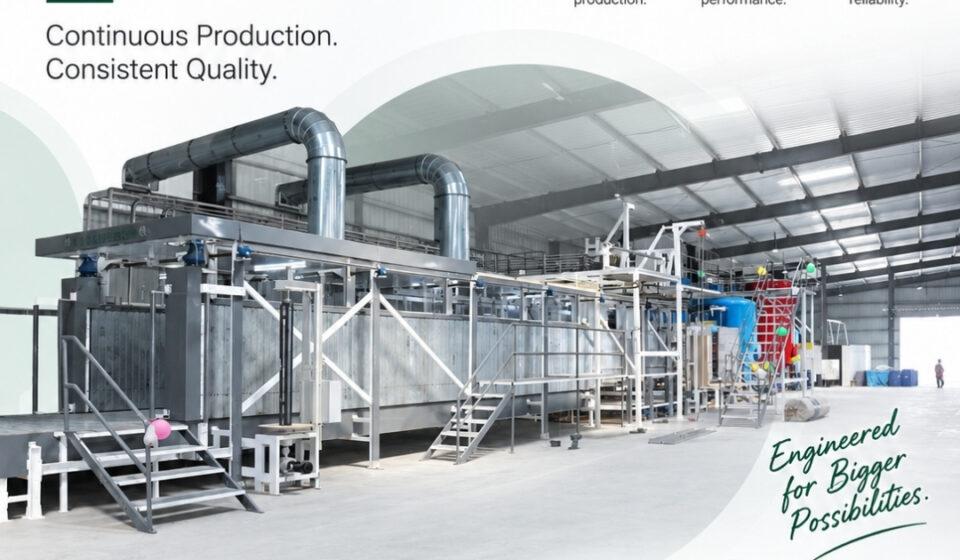
A Continuous Foaming Machine is designed to facilitate the continuous production of flexible polyurethane foam. It enables raw materials to be processed through a controlled foaming system, allowing manufacturers to produce foam blocks according to specific production requirements. With suitable machine configurations and process controls, manufacturers can achieve consistent foam characteristics and maintain an organized production workflow.
Understanding the Continuous Foam Production Process
Continuous foam production involves the controlled mixing and processing of raw materials to create polyurethane foam. During this process, different chemical components are accurately measured, mixed, and dispensed to initiate the foaming reaction. The resulting mixture expands and forms a continuous foam block, which is subsequently processed according to the required dimensions.
Modern continuous foaming machines are developed to support this manufacturing process with greater operational consistency. Maintaining appropriate processing parameters is important for achieving the desired foam density, structure, and overall quality.
Unlike production methods that rely on separate batches, continuous manufacturing systems are designed to maintain a steady production flow. This makes continuous foam production equipment particularly useful for businesses that need to fulfil regular and high-volume manufacturing requirements.
Key Advantages of Continuous Foam Manufacturing Machinery
Selecting suitable foam manufacturing machinery can influence the overall efficiency of a polyurethane foam production facility. Continuous production systems offer several potential advantages for manufacturers.
- Consistent Foam Quality
Maintaining uniform foam characteristics is essential for producing reliable end products. Proper control over raw material mixing and processing conditions can help manufacturers achieve more consistent foam density and structure throughout production.
- Improved Production Efficiency
Continuous processing helps reduce interruptions associated with separate production batches. This can support a smoother workflow and allow manufacturers to manage larger production requirements more effectively.
- Better Process Control
Modern PU foam production machines can be configured with suitable control systems to monitor important production parameters. This helps operators manage the foaming process and maintain the required manufacturing conditions.
- Support for Large Production Volumes
Manufacturers supplying bulk foam requirements can benefit from machinery designed for continuous operation. Appropriate equipment selection can help businesses manage increasing production demands.
- Flexible Manufacturing Requirements
Depending on the machine configuration, production systems can be selected according to foam density, block dimensions, output capacity, and raw material specifications.
Industrial Applications of Continuous Foaming Machines
A PU foam production machine is useful across several industries where polyurethane foam is required as a primary or supporting material.
- Mattress Industry: Flexible polyurethane foam is widely used in mattress cores, cushioning layers, and bedding products.
- Furniture Manufacturing: Foam is an essential material for sofas, chairs, cushions, and upholstered furniture.
- Automotive Industry: Polyurethane foam is used in vehicle seating, interior cushioning, and other automotive applications.
- Packaging Industry: Foam materials provide cushioning and protection for various products during storage and transportation.
- Insulation Applications: Specific polyurethane foam formulations are used in thermal insulation and related industrial applications.
These diverse applications create a need for dependable PU foam processing equipment that can support different manufacturing specifications.
Factors to Consider When Selecting PU Foam Production Equipment
Choosing the right machinery requires an understanding of the facility’s production goals and operational requirements. Manufacturers should evaluate several factors before investing in a continuous foaming system.
Production capacity is an important consideration, particularly for businesses handling large quantities of foam. The required foam density, block dimensions, raw material specifications, and expected output should also be assessed.
Other important considerations include machine configuration, automation requirements, available factory space, maintenance needs, and operator requirements. Evaluating these aspects can help manufacturers identify suitable continuous foam production equipment for their facilities.
Working with an experienced machinery manufacturer can further help businesses understand available configurations and select equipment that aligns with their production objectives.
Upgrade Your Foam Manufacturing Setup with A S Enterprises
Efficient polyurethane foam manufacturing depends on suitable machinery, controlled processing, and a well-organized production environment. Investing in reliable continuous foaming machines can help manufacturers improve production management while supporting consistent foam output.
A S Enterprises offers industrial machinery solutions for polyurethane foam manufacturing. Businesses exploring PU foam production equipment can learn more about its continuous foaming solution and evaluate its suitability for their manufacturing requirements.
Explore the Continuous Foaming Machine by A S Enterprises to learn more about equipment designed for continuous polyurethane foam production.