





Selecting a blockchain development company in Malaysia requires more than comparing development quotations or reviewing a portfolio of decentralized applications. Founders, CTOs and fintech executives need a technology partner that understands blockchain architecture, smart contract security, application integration and long-term infrastructure requirements.
A blockchain project may involve decentralized applications (dApps), tokenization platforms, digital asset management, financial transactions or enterprise blockchain networks. Each use case requires different technical expertise, security controls and development approaches.
Choosing the wrong development partner can result in vulnerable smart contracts, expensive infrastructure changes, integration problems and applications that cannot support production workloads.
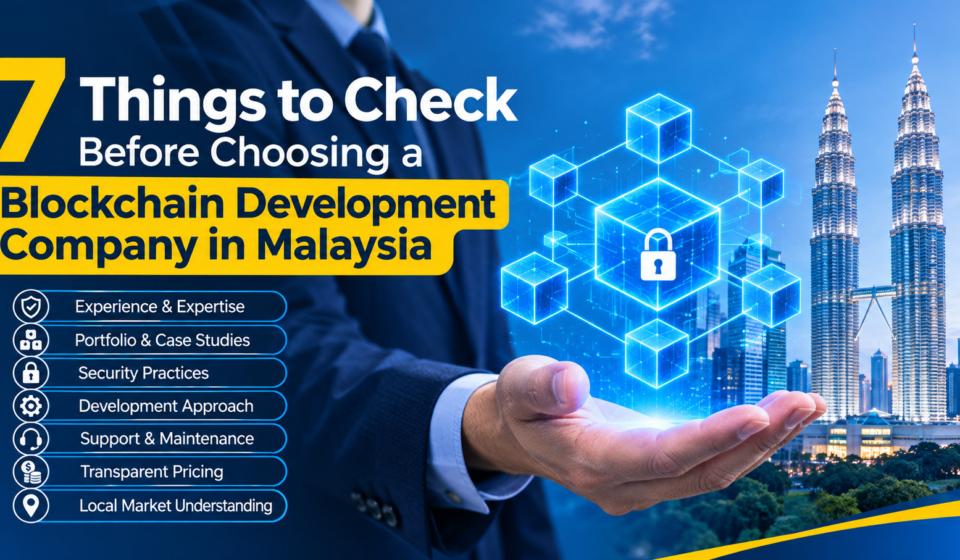
Before hiring a blockchain development company in Malaysia, evaluate these seven factors to identify a suitable engineering partner.
1. Evaluate Blockchain Development Experience and Technical Expertise
Start by examining the company’s blockchain engineering capabilities. A development partner should understand different blockchain architectures and recommend technologies based on the project’s actual requirements.
For example, Ethereum and Polygon support smart contract development and decentralized applications, while Hyperledger Fabric is designed for permissioned enterprise blockchain networks.
Depending on the use case, relevant technical expertise may include:
- Ethereum and EVM-compatible blockchain development.
- Solidity smart contract development.
- Hyperledger Fabric and enterprise blockchain.
- Polygon and other blockchain networks.
- Web3 application development.
- Wallet and payment integrations.
- Blockchain APIs and backend engineering.
What to check: Ask the company to explain its experience with the blockchain network, programming languages, development frameworks and infrastructure relevant to your project.
A capable blockchain development agency should also explain why a particular blockchain architecture is appropriate instead of recommending the same technology for every business requirement.
2. Review Smart Contract Development and Security Practices
Smart contracts execute predefined business rules on blockchain networks. Errors in contract logic can create financial exposure, unauthorized transactions and vulnerabilities that may be difficult to correct after deployment.
This makes smart contract security one of the most important evaluation criteria when selecting blockchain developers in Malaysia.
Assess whether the development company follows established security practices, including:
- Smart contract code reviews.
- Unit and integration testing.
- Automated vulnerability analysis.
- Reentrancy and access control testing.
- Gas optimization.
- Secure key management.
- Independent security audits where appropriate.
For example, a decentralized finance application may require additional protection against flash loan attacks, price manipulation and unauthorized fund transfers.
What to check: Request details about the company’s testing methodology, security assessment process and experience handling smart contract vulnerabilities.
Do not treat successful compilation or deployment as proof of contract security. Independent audits may also be appropriate for applications managing substantial digital assets.
3. Examine Previous Blockchain Projects and Case Studies
A company’s portfolio provides evidence of its engineering experience and ability to deliver blockchain applications.
However, reviewing project names alone is insufficient. Founders and CTOs should examine the technical complexity, business requirements and actual development responsibilities behind each project.
Look for experience in areas such as:
- Decentralized application development.
- Smart contract engineering.
- Tokenization platforms.
- Digital asset management.
- Blockchain-based payment systems.
- Enterprise blockchain applications.
- Web3 platforms and wallet integrations.
What to check: Ask for case studies explaining the project’s objectives, blockchain architecture, development challenges, implemented security measures and production outcomes.
If a company cannot share confidential client information, it should still be able to explain its technical approach through anonymized project examples or demonstrations.
4. Assess Blockchain Consulting and Solution Architecture
Not every business problem requires blockchain technology. An experienced development partner should evaluate whether a decentralized architecture provides meaningful advantages over conventional databases and centralized applications.
Blockchain consulting helps businesses assess technical feasibility, infrastructure requirements, transaction models and implementation risks before development begins.
Important consulting considerations include:
- Public versus private blockchain selection.
- Permissioned versus permissionless architecture.
- Consensus mechanisms.
- On-chain and off-chain data management.
- Transaction throughput and scalability.
- Wallet and identity management.
- Regulatory and operational considerations.
For example, a supply chain company may benefit from a permissioned blockchain when multiple independent organizations need shared transaction records. A conventional database may be more appropriate when a single organization controls the entire workflow.
What to check: Ask for a technical discovery process, architecture proposal and documented explanation of why blockchain is appropriate for your business model.
A reliable blockchain development company should be willing to identify situations where blockchain is unnecessary.
5. Verify Integration Capabilities and Custom Software Engineering
Blockchain applications rarely operate independently. Most business projects require integration with existing enterprise applications, financial infrastructure, customer platforms and external services.
A blockchain development company should demonstrate experience in custom software development services alongside blockchain engineering.
Relevant integration capabilities include:
- ERP and CRM integration.
- Payment gateway connectivity.
- API development and integration.
- Web and mobile application development.
- Database integration.
- Identity and authentication systems.
- Cloud infrastructure and deployment.
For example, a fintech company developing a digital asset platform may need to connect smart contracts with user accounts, payment services, transaction monitoring and administrative dashboards.
What to check: Evaluate whether the company can develop both blockchain components and the supporting software infrastructure.
A software development agency with strong backend, frontend, API and cloud engineering capabilities can be valuable when the project requires more than smart contract development.
6. Compare Development Costs, Delivery Processes and Ongoing Support
Blockchain development services costs vary according to architecture complexity, smart contract functionality, security requirements, application interfaces and integration scope.
A basic smart contract implementation has different engineering requirements from a complete Web3 platform involving wallets, token management, transaction monitoring and enterprise integrations.
When comparing proposals, evaluate:
| Evaluation factor | What to examine |
| Discovery | Business analysis and technical feasibility |
| Architecture | Blockchain selection and infrastructure design |
| Development | Smart contracts, backend and frontend |
| Security | Testing, code reviews and independent audits |
| Integration | APIs, wallets and third-party applications |
| Deployment | Network configuration and production release |
| Maintenance | Monitoring, upgrades and technical support |
What to check: Request an itemized proposal that explains deliverables, milestones, assumptions, exclusions and post-launch responsibilities.
Also clarify intellectual property ownership, source code access, documentation, infrastructure ownership and maintenance arrangements.
The lowest quotation may not represent the lowest total project cost if it excludes security testing, integration or ongoing support.
7. Evaluate Regulatory Awareness, Data Security and Long-Term Scalability
Blockchain projects operating in Malaysia may involve financial services, digital assets, personal information and cross-border transactions. These areas require careful consideration of applicable regulatory obligations.
For example, businesses exploring digital asset activities should understand the relevant requirements of the Securities Commission Malaysia (SC), particularly where regulated digital asset offerings or recognized market operators are involved.
Organizations handling personal information should also assess applicable obligations under Malaysia’s Personal Data Protection Act 2010 (PDPA), including relevant amendments.
A suitable development partner should consider:
- Data protection and privacy requirements.
- Smart contract security.
- Wallet and private key protection.
- Transaction monitoring requirements.
- Access control and identity management.
- Blockchain infrastructure availability.
- Application performance and scalability.
What to check: Ask how the company addresses security, privacy, infrastructure monitoring and applicable regulatory requirements during development.
Technical development expertise does not automatically establish legal or regulatory compliance. Businesses should obtain appropriate professional advice for regulated activities.
Blockchain Development Companies in Malaysia to Consider
After evaluating technical expertise, security, integration capabilities and delivery processes, businesses can shortlist technology providers based on their project requirements.
The following companies offer different technology capabilities relevant to software engineering, enterprise systems, financial technology or blockchain-related projects. They should not be treated as interchangeable blockchain specialists. Verify current blockchain service availability, project experience and delivery capabilities directly before making a procurement decision.
1. Nagorik Technologies
Best for: Custom software development, AI, cybersecurity and Blockchain
Implementation orientation: Custom software, blockchain engineering, API integration, cloud solutions and enterprise application development.
Our consideration:
Nagorik Technologies is an AI-native enterprise software engineering company headquartered in Kuala Lumpur, Malaysia. The company develops custom software solutions and enterprise applications for established organizations across Malaysia and international markets.
Its engineering capabilities cover blockchain and Web3 development, smart contract-related solutions, custom application engineering, API integration, cloud technologies and cybersecurity.
With 200+ in-house engineers and dedicated R&D capabilities, Nagorik Technologies brings broader software engineering expertise to projects that require blockchain functionality alongside backend systems, user interfaces, integrations and enterprise infrastructure.
For businesses developing blockchain-enabled platforms, this combination is relevant when the project requires more than isolated smart contract development.
2. Silverlake Axis
Best for: Financial technology and banking software solutions.
Implementation orientation: Core banking platforms, digital financial services and enterprise financial technology.
Our consideration:
Silverlake Axis is a Malaysia-origin technology company with an established presence in financial services software. Its expertise includes banking platforms and digital financial infrastructure.
Fintech organizations evaluating technology partners can consider its financial software background when assessing complex banking and enterprise application requirements. However, its suitability for a specific blockchain project should be confirmed against its current blockchain capabilities.
3. HeiTech Padu Berhad
Best for: Enterprise systems integration and large-scale IT projects.
Implementation orientation: Enterprise IT, systems integration and digital infrastructure.
Our consideration:
HeiTech Padu Berhad operates in Malaysia’s enterprise technology sector, with capabilities in systems integration and IT solutions.
Its experience in enterprise technology environments makes it relevant to organizations assessing complex infrastructure and application implementation requirements. Buyers should confirm whether its current services cover their specific blockchain development needs.
4. Mesiniaga Berhad
Best for: Enterprise infrastructure and technology modernization.
Implementation orientation: IT infrastructure, cloud solutions, cybersecurity and digital transformation.
Our consideration:
Mesiniaga Berhad provides enterprise technology and IT infrastructure solutions in Malaysia. Its capabilities are relevant to organizations modernizing their technology environments and strengthening infrastructure.
For blockchain projects involving enterprise infrastructure, cloud environments and security requirements, businesses can assess its technical suitability and specific blockchain development experience.
5. Fusionex
Best for: Data analytics and enterprise intelligence.
Implementation orientation: Data analytics, business intelligence and data-driven enterprise applications.
Our consideration:
Fusionex has been associated with big data analytics and enterprise intelligence solutions. Its historical technology focus is relevant to discussions involving enterprise data processing and analytics.
However, prospective buyers should independently verify its current operating status, service availability and blockchain engineering capabilities before considering it for a new project.
Final Checklist Before Hiring a Blockchain Development Company
Use this checklist when comparing proposals from blockchain developers in Malaysia.
- Demonstrated blockchain engineering experience.
- Smart contract development and security testing capabilities.
- Relevant project case studies.
- Blockchain consulting and architecture expertise.
- Custom software and API integration capabilities.
- Transparent pricing and delivery milestones.
- Source code ownership and ongoing maintenance arrangements.
- Understanding of applicable Malaysian regulatory requirements.
Frequently Asked Questions
1. How do I choose a blockchain development company in Malaysia?
Evaluate blockchain expertise, smart contract security, previous projects, architecture consulting, integration capabilities, development costs and ongoing support. Request technical documentation and project references before selecting a development partner.
2. How much does blockchain development cost in Malaysia?
Blockchain development costs depend on smart contract complexity, blockchain selection, application functionality, security requirements and integration scope. A basic smart contract project generally requires less engineering than a complete enterprise Web3 platform.
3. What services should a blockchain development company provide?
Relevant services may include blockchain consulting, smart contract development, decentralized application development, Web3 development, tokenization, wallet integration, blockchain API development, security testing and ongoing application maintenance.
4. Why is smart contract auditing important?
Smart contract auditing identifies vulnerabilities, logical errors and security weaknesses before deployment. It is particularly important for applications handling digital assets, financial transactions and automated contract execution.
5. Which blockchain is suitable for Malaysian businesses?
The right blockchain depends on business requirements. Ethereum and EVM-compatible networks can support decentralized applications, while Hyperledger Fabric may suit permissioned enterprise environments. Architecture selection should consider transaction costs, security, scalability, governance and regulatory requirements.
6. What is the difference between blockchain development and Web3 development?
Blockchain development focuses on blockchain infrastructure, network architecture and smart contracts. Web3 development includes these components alongside decentralized applications, wallets, user interfaces and integrations that allow users to interact with blockchain networks.
Conclusion
Choosing a blockchain development company in Malaysia requires careful evaluation of engineering capabilities, security practices, project experience and long-term support. Smart contract expertise alone is insufficient for projects involving financial applications, enterprise integrations or complete Web3 platforms.
Founders, CTOs and fintech decision-makers should compare development partners based on their ability to translate business requirements into secure, scalable and maintainable software.
A company with blockchain engineering expertise and broader custom software development capabilities can provide a stronger foundation for applications that must connect decentralized technology with existing business infrastructure.