






Introduction
Digital marketing has become one of the fastest-growing fields in today’s business world. Almost every business, whether small or large, uses online platforms to promote its products and services, connect with customers, and increase sales. As a result, the demand for skilled digital marketing professionals is growing across different industries.
For students and freshers who want to start a career in this field, preparing for interviews is an important step. Having theoretical knowledge is useful, but understanding practical concepts and knowing how digital marketing tools work can make a big difference during an interview.
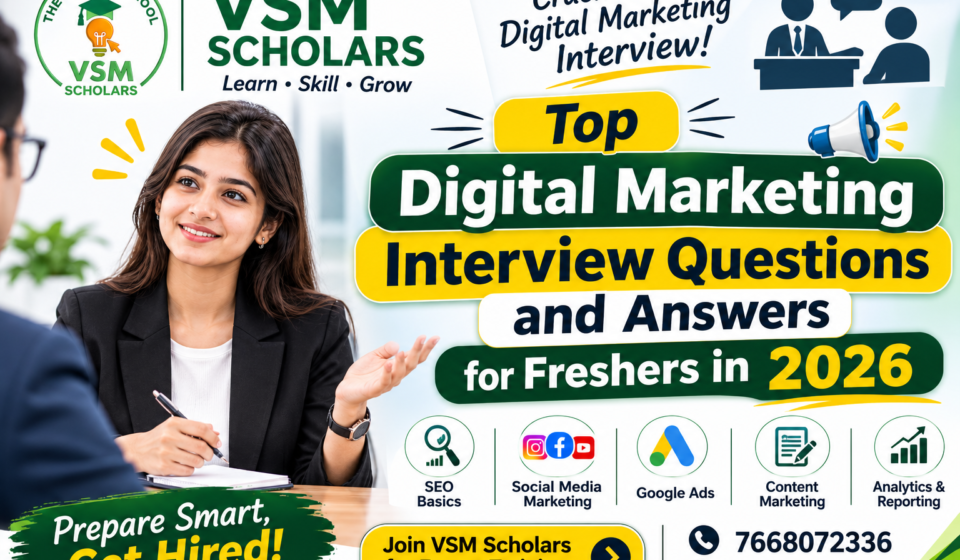
Practising digital marketing interview questions and answers helps candidates improve their knowledge, develop confidence, and prepare for different job opportunities. Interviewers generally ask questions related to SEO, social media marketing, Google Ads, content marketing, email marketing, website analytics, and online advertising.
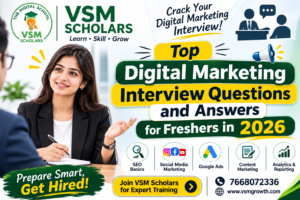
In this blog, we will explore the most important digital marketing interview questions and answers for freshers in 2026, along with preparation tips and career opportunities.
What Is Digital Marketing?
Digital marketing is the process of promoting products, services, and brands through digital platforms such as search engines, websites, social media, email, and online advertising networks.
Businesses use digital marketing to reach their target audience, increase brand awareness, generate leads, and improve sales.
Some important areas of digital marketing include:
- Search Engine Optimization (SEO)
- Social Media Marketing (SMM)
- Google Ads and PPC Advertising
- Content Marketing
- Email Marketing
- Affiliate Marketing
- Website Analytics
- Online Reputation Management
Understanding these areas is important for anyone preparing for a digital marketing interview.
Top 20 Digital Marketing Interview Questions and Answers for Freshers
Below are some commonly asked interview questions that can help beginners prepare for entry-level digital marketing positions.
Q1. What Is Digital Marketing?
Answer: Digital marketing is the process of promoting products and services using online platforms such as Google, Facebook, Instagram, websites, and email. It helps businesses reach potential customers through digital channels.
Q2. What Is SEO?
Answer: SEO stands for Search Engine Optimization. It is the process of improving a website’s visibility in organic search engine results. SEO includes keyword research, on-page SEO, off-page SEO, technical SEO, and content optimization.
Q3. What Are Keywords in Digital Marketing?
Answer: Keywords are words or phrases that people enter into search engines when looking for information, products, or services. Digital marketers use relevant keywords in website content to help search engines understand the topic of a page.
For example, “digital marketing institute in Meerut” is a keyword that students may search for when looking for digital marketing training.
Q4. What Is Social Media Marketing?
Answer: Social Media Marketing (SMM) is the process of promoting a business, brand, product, or service through social media platforms such as Facebook, Instagram, LinkedIn, and YouTube.
It includes creating posts, reels, stories, videos, running advertisements, and engaging with followers.
Q5. What Is Google Ads?
Answer: Google Ads is an online advertising platform developed by Google. It allows businesses to display paid advertisements on Google Search, YouTube, websites, and other advertising placements.
Businesses can use Google Ads to reach people searching for specific products and services.
Q6. What Is PPC?
Answer: PPC stands for Pay-Per-Click. It is an online advertising model in which advertisers generally pay when someone clicks on their advertisement.
For example, a business can run a Google Search campaign and pay for clicks generated by its advertisements.
Q7. What Is On-Page SEO?
Answer: On-page SEO refers to optimizing individual website pages to improve their search engine visibility. It includes optimizing title tags, meta descriptions, headings, URLs, images, internal links, and website content.
Q8. What Is Off-Page SEO?
Answer: Off-page SEO includes activities performed outside a website to improve its authority, reputation, and online presence. It includes earning quality backlinks, guest posting, digital PR, and relevant brand mentions.
Q9. What Is Technical SEO?
Answer: Technical SEO focuses on improving the technical structure of a website so that search engines can crawl and index its pages effectively.
It includes improving website speed, mobile friendliness, HTTPS security, XML sitemaps, robots.txt files, and fixing indexing problems.
Q10. What Is Content Marketing?
Answer: Content marketing is a strategy that involves creating and sharing valuable and informative content to attract and engage a target audience.
Examples include blogs, articles, videos, infographics, social media posts, and email newsletters.
Q11. What Is Google Analytics 4?
Answer: Google Analytics 4 (GA4) is an analytics platform used to understand how visitors interact with websites and mobile applications.
It helps marketers analyze traffic sources, user engagement, conversions, and other important performance metrics.
Q12. What Is Google Search Console?
Answer: Google Search Console is a free tool provided by Google that helps website owners monitor their website’s performance in Google Search.
It provides information about search queries, clicks, impressions, indexing issues, and website search visibility.
Q13. What Is a Backlink?
Answer: A backlink is a link from another website that points to your website. Quality backlinks from relevant and trustworthy websites can help improve website authority and support SEO performance.
Q14. What Is Keyword Research?
Answer: Keyword research is the process of identifying search terms that people use when looking for information, products, or services online.
Digital marketers use keyword research to understand search demand and create relevant website content.
Some popular keyword research tools include Google Keyword Planner, Google Trends, Ahrefs, and SEMrush.
Q15. What Is Meta Description?
Answer: A meta description is a short summary of a webpage’s content. It may appear below the page title in search engine results and helps users understand what the page is about.
A relevant and attractive meta description can encourage users to click on a search result.
Q16. What Is Email Marketing?
Answer: Email marketing is a digital marketing strategy used to communicate with customers through email. Businesses use it to share promotional offers, newsletters, product updates, and useful information.
It can help build customer relationships and encourage repeat purchases.
Q17. What Is Lead Generation?
Answer: Lead generation is the process of attracting potential customers and collecting their contact information so that a business can follow up with them.
Common lead-generation methods include landing pages, contact forms, social media campaigns, Google Ads, and Meta Ads.
Q18. What Is the Difference Between Organic and Paid Marketing?
Answer: Organic marketing focuses on attracting visitors naturally without paying for every click or impression. Examples include SEO, organic social media posts, and informative blogs.
Paid marketing involves paying advertising platforms to promote products or services. Examples include Google Ads and Facebook or Instagram advertisements.
Both strategies can work together to improve business visibility.
Q19. What Is a Conversion in Digital Marketing?
Answer: A conversion happens when a visitor completes a desired action on a website or advertising platform.
Examples include purchasing a product, submitting an inquiry form, signing up for a newsletter, or making a phone call.
Q20. What Is the Difference Between Reach and Impressions?
Answer: Reach refers to the number of unique people who see a piece of content or advertisement.
Impressions refer to the total number of times the content or advertisement is displayed. One person can generate multiple impressions.
Important Digital Marketing Tools Freshers Should Know
Apart from theoretical knowledge, freshers should understand commonly used digital marketing tools. These tools help professionals perform marketing activities and analyze campaign performance.
Here are some useful tools:
- Google Analytics 4: Used to understand website traffic and user behaviour.
- Google Search Console: Helps monitor website performance in Google Search.
- Google Keyword Planner: Used for keyword research and advertising planning.
- Google Ads: Helps businesses run paid advertising campaigns.
- Meta Ads Manager: Used to create and manage Facebook and Instagram advertisements.
- Canva: Helps create social media graphics, presentations, and marketing designs.
- SEMrush: Supports keyword research, competitor analysis, and SEO activities.
- Ahrefs: Used for backlink analysis, keyword research, and SEO research.
- ChatGPT: Can assist with content ideas, research, marketing drafts, and brainstorming.
- Google Trends: Helps explore search interest and trending topics.
Learning how to use these tools can give freshers an advantage during interviews and practical assignments.
Tips to Prepare for Digital Marketing Interviews in 2026
Preparing for an interview requires more than memorizing definitions. Candidates should understand how digital marketing works in real business situations.
Here are some useful preparation tips:
1. Understand Basic Digital Marketing Concepts
Start by learning SEO, social media marketing, Google Ads, PPC, content marketing, and email marketing. Understand the purpose of each strategy and how businesses use it.
2. Practise Keyword Research
Learn how to find relevant keywords using tools such as Google Keyword Planner and Google Trends. Practise selecting keywords for different business categories.
3. Learn Social Media Content Planning
Understand how to create Instagram posts, reels, stories, and Facebook campaigns. Learn how to write captions, select hashtags, and plan a content calendar.
4. Explore Google Ads and Meta Ads
Understand the basic structure of advertising campaigns, audience targeting, budgets, ad creatives, and campaign objectives.
5. Work on Practical Projects
Create a sample website, write SEO-friendly blogs, design social media posts, or prepare a sample advertising campaign. Practical projects give you something meaningful to discuss during an interview.
6. Prepare Your Resume
Create a professional resume that highlights your digital marketing knowledge, practical skills, certifications, tools, and projects.
Freshers can include academic projects and practice campaigns even if they do not have professional experience.
7. Practise Communication Skills
During interviews, explain your answers clearly and confidently. If you do not know something, be honest and show your willingness to learn.
Career Opportunities After Learning Digital Marketing
Digital marketing offers different career opportunities for students, graduates, and freshers. After developing the required skills, candidates can explore roles such as:
- SEO Executive
- Digital Marketing Executive
- Social Media Executive
- Google Ads Executive
- PPC Specialist
- Content Marketing Executive
- Email Marketing Executive
- Digital Marketing Analyst
- Social Media Manager
- Performance Marketing Executive
Career growth depends on practical experience, technical knowledge, communication skills, and the ability to deliver results.
Freshers can start with entry-level positions and gradually develop expertise in specialized areas of digital marketing.
Why Choose VSM Scholars for Digital Marketing Training?
Choosing the right institute is an important step for students who want to build a career in digital marketing.
VSM Scholars – The Digital School helps students develop digital marketing knowledge through structured learning and practical exposure.
Students can explore important digital marketing subjects, including:
- Search Engine Optimization (SEO)
- Social Media Marketing
- Google Ads
- Facebook and Instagram Ads
- Content Marketing
- Graphic Designing
- Video Editing
- Website Optimization
- Exposure to 20+ AI Tools
The learning approach focuses on helping students understand marketing concepts and develop practical skills that are useful in professional environments.
VSM Scholars also provides 100% Placement Assistance to support students as they explore career opportunities and prepare for the job market.
Whether you are a student, recent graduate, or beginner interested in online marketing, learning through practical activities can help you develop confidence and understand industry requirements.
Conclusion
Digital marketing is an exciting career option for students and freshers in 2026. As businesses continue to use online platforms to connect with customers, the need for skilled digital marketing professionals is creating opportunities across different industries.
Preparing for interviews by practising digital marketing interview questions and answers can help candidates understand important concepts and improve their confidence.
From SEO and social media marketing to Google Ads, content marketing, and analytics, developing knowledge of different digital marketing areas is essential for beginners.
Along with theoretical knowledge, students should focus on practical projects, digital marketing tools, communication skills, and continuous learning.
If you want to start your journey in digital marketing, join VSM Scholars and develop the skills needed to explore exciting career opportunities.
Start learning today and take your first step towards a successful digital marketing ca– Learn • Create • Grow!