







Businesses are always looking for ways to save time, reduce manual work, and improve operational efficiency. Automation has become an important part of achieving these goals. From sending customer emails to managing invoices and updating business records, companies use automation to complete repetitive tasks with less human involvement.
However, traditional automation is not always enough to handle modern business requirements. Many business processes involve changing information, customer requests, unstructured data, and decisions that cannot be managed through fixed rules alone. This is where AI Workflow Automation becomes useful.
Although both approaches help businesses reduce manual work, they operate differently. Traditional automation follows predefined instructions, while AI-powered systems can understand information, recognize patterns, and support decisions based on the data they receive.
For example, a traditional system can send an automatic email whenever a customer submits a contact form. An intelligent workflow can go further by understanding the customer’s message, identifying their requirements, categorizing the inquiry, and directing it to the appropriate sales representative.
Understanding these differences can help businesses select the right solution for their operations. In this guide, we will explain how both approaches work, their benefits, practical examples, and how to decide which one is suitable for your business.
What Is Traditional Automation?
Traditional automation refers to technology that performs repetitive tasks by following predefined rules and instructions. It works according to conditions established by developers or business teams.
In simple terms, businesses tell the system what action to perform when a particular condition occurs.
For example:
-
When a customer submits a form, send a confirmation email.
-
When an invoice is created, update the accounting record.
-
When a payment is received, change the invoice status.
-
When an employee submits a leave request, notify the manager.
These processes do not require the system to understand the meaning behind the information. It simply checks whether a specific condition has been met and performs the assigned action.
How Does Traditional Automation Work?
Traditional automation generally follows a straightforward process:
-
Define the task: Identify the repetitive business activity that needs automation.
-
Set the rules: Establish conditions that determine when an action should happen.
-
Configure the workflow: Connect the applications and systems involved in the process.
-
Execute the task: The system performs the assigned action when the conditions are satisfied.
-
Monitor the results: Business teams check whether the workflow is operating correctly.
For example, an e-commerce company can create a rule that automatically sends an order confirmation email after a customer completes a purchase.
The process works consistently because the instructions remain fixed. However, if a customer sends an unusual request or provides information in an unexpected format, the system may require manual intervention.
What Is AI Workflow Automation?
AI Workflow Automation combines artificial intelligence with business process automation to manage tasks that require more than predefined instructions.
Instead of only following fixed rules, these systems can analyze information, identify patterns, understand text, and support decisions based on the available data.
This makes them useful for business processes involving customer communication, document processing, data analysis, sales operations, and customer support.
For example, imagine a company receives hundreds of customer emails every day. A traditional system might send the same confirmation message to every customer. An intelligent workflow can analyze the email content, identify whether the customer needs technical assistance, pricing information, or product support, and direct the message to the relevant department.
How Does AI Workflow Automation Work?
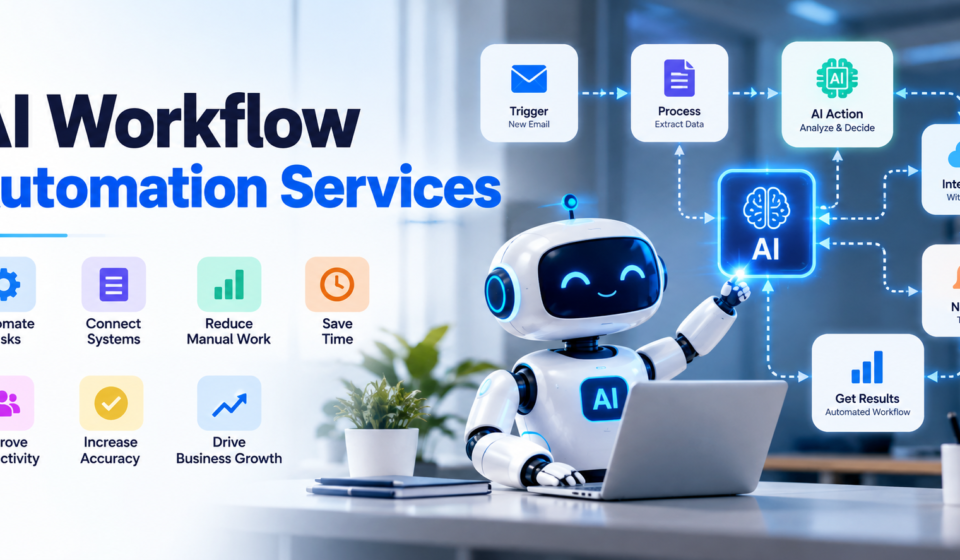
The process combines different technologies to manage business activities more intelligently.
1. Collecting business information
The system receives information from emails, forms, CRM platforms, documents, databases, or other connected applications.
2. Understanding the information
AI technologies such as natural language processing (NLP) can help interpret customer messages, extract important details, and identify the purpose of a request.
3. Analyzing and making decisions
Based on the available information, the system identifies the appropriate next action. The decision may depend on customer requirements, business conditions, historical information, or predefined policies.
4. Performing automated actions
The workflow can update records, send personalized responses, create tasks, assign requests, or transfer information between applications.
5. Learning and improving
Depending on the technology and configuration, machine learning systems can use feedback and new data to improve their performance over time. Human review remains important, particularly when decisions have financial, legal, or customer impact.
The main advantage is that businesses can manage more complex processes without creating a separate fixed rule for every possible situation.
AI Workflow Automation vs. Traditional Automation: Key Differences
Both approaches improve productivity, but their capabilities and applications are different. Understanding these differences makes it easier to choose the right automation strategy.
1. Working Method
The biggest difference is how each system handles tasks.
Traditional automation follows predefined instructions. If the system receives information that does not match its configured rules, it may fail to complete the task or send it for manual review.
AI Workflow Automation can analyze the information before deciding what action should happen next.
For example, a traditional system can send a payment reminder seven days after an invoice becomes overdue. An intelligent system may also consider the customer’s email response, payment history, and invoice information before suggesting the next step.
2. Decision-Making Capabilities
Traditional automation uses fixed conditions to determine the next action. It cannot independently interpret complex situations outside its configured logic.
Intelligent automation can evaluate information using AI models and identify possible actions based on context.
For instance, a customer support system using traditional rules may send a request containing the word “refund” to the billing department.
An intelligent system can examine the complete message to understand whether the customer is asking about refund eligibility, reporting a failed transaction, or requesting an update on an existing refund.
3. Handling Unstructured Data
Traditional automation works particularly well with structured information, such as numbers, dates, dropdown selections, and standard form fields.
However, businesses also receive information through PDFs, scanned documents, emails, images, and free-text messages.
AI Workflow Automation can use technologies such as OCR, NLP, and machine learning to extract and interpret information from these sources.
For example, an accounting department may receive invoices from different suppliers. Each invoice may have a different layout. AI-powered document processing can extract details such as invoice numbers, dates, supplier names, and total amounts.
Traditional systems may require additional rules or templates for different invoice formats.
4. Flexibility and Adaptability
Traditional workflows are generally predictable but less flexible. If business requirements change, developers may need to update the existing rules.
AI-powered workflows can handle certain variations in information without requiring a separate rule for every situation.
However, flexibility does not mean complete independence. AI systems still need appropriate data, configuration, testing, and monitoring.
5. Implementation and Maintenance
Traditional automation can be relatively simple to implement when the business process is stable and clearly defined.
For example, automatically updating a CRM field after a form submission may require only a basic workflow configuration.
Intelligent automation can require additional work, including model selection, data preparation, integration, testing, security controls, and performance monitoring.
Businesses should consider these requirements before choosing a solution.
6. Accuracy and Reliability
Traditional automation can provide highly consistent results when the input follows an expected format and the rules are correctly configured.
AI-powered workflows can handle more complicated information, but their results may vary depending on data quality, model performance, and the complexity of the task.
For this reason, businesses should introduce human approval for sensitive activities such as financial transactions, contract decisions, and important customer communications.
Comparison Table: Traditional vs. Intelligent Automation
| Comparison Factor | Traditional Automation | AI-Powered Automation |
|---|---|---|
| Working method | Fixed rules | AI-supported decisions |
| Decision-making | Rule-based | Context-based analysis |
| Data handling | Mainly structured data | Structured and unstructured data |
| Flexibility | Limited to configured rules | Can handle certain variations |
| Learning ability | Does not learn independently | Can improve through feedback and training |
| Implementation | Often simpler | May require additional setup |
| Maintenance | Rule updates | Model and workflow monitoring |
| Best suited for | Repetitive tasks | Complex and changing processes |
Real-World Examples of Both Automation Approaches
Understanding practical applications can help businesses identify where each approach provides value.
1. Customer Support Management
Customer support teams receive different types of requests throughout the day.
With traditional automation, a company can create rules that assign support tickets based on selected categories. For example, requests marked as “Billing” automatically go to the finance team.
With intelligent automation, the system can analyze the customer’s complete message, identify the issue, determine its urgency, and recommend the appropriate department.
Business benefit: Faster ticket handling, better request organization, and less manual sorting.
2. Invoice and Accounting Management
Accounting teams regularly process invoices, payment confirmations, and financial documents.
Traditional automation can update invoice statuses, send payment reminders, and generate recurring reports.
An intelligent workflow can extract information from different invoice formats, identify missing details, and flag unusual entries for review.
Business benefit: Reduced manual data entry and more efficient document processing.
3. Sales and CRM Management
Sales teams use CRM platforms to manage customer information, follow-ups, and business opportunities.
Traditional automation can send follow-up emails after a fixed number of days or create tasks when a new lead enters the CRM.
AI-powered systems can analyze lead information, summarize previous conversations, identify customer interests, and help sales representatives prioritize opportunities.
Business benefit: Better lead management and more informed sales decisions.
4. Employee Management
HR departments handle applications, employee records, leave requests, and internal communication.
Traditional automation can notify managers when employees submit leave requests or automatically update attendance records.
Intelligent workflows can help extract information from resumes, categorize applications, and summarize candidate experience for recruiters.
Business benefit: Less administrative work and faster information processing.
Benefits of AI Workflow Automation for Modern Businesses
As business operations become more complex, companies need solutions that can handle both repetitive activities and information-based tasks.
Here are some important benefits.
Reduced Manual Work
Employees often spend considerable time reading emails, entering information, updating records, and transferring data between applications.
Intelligent automation can handle many of these activities, allowing employees to focus on customer relationships, business planning, and other important responsibilities.
Improved Operational Efficiency
Connected workflows reduce unnecessary steps between departments. Information can move between CRM, ERP, accounting, and customer support systems with less manual involvement.
This helps businesses improve turnaround times and maintain smoother operations.
Better Customer Experiences
Customers expect timely responses and relevant communication.
An intelligent workflow can analyze incoming requests and help businesses provide more relevant responses. It can also direct complex requests to the right employees instead of treating every inquiry in the same way.
Better Use of Business Data
Businesses collect information from multiple sources, but that information is not always easy to organize or analyze.
AI-powered systems can help extract useful details, summarize information, identify patterns, and make business data easier to work with.
Easier Business Process Scaling
As a business grows, the number of customer requests, transactions, and internal activities also increases.
A properly designed automation system can help manage higher workloads without requiring businesses to increase manual effort at the same rate.
When Should Businesses Choose Traditional Automation?
Not every business activity requires artificial intelligence. Traditional automation is still a practical option for processes that are predictable, repetitive, and based on clear instructions.
Consider traditional automation when:
-
The task follows the same steps every time.
-
Business rules are clearly defined.
-
The information is structured and consistent.
-
The workflow does not require complex decisions.
-
The company wants a straightforward solution for a specific task.
-
The cost and complexity of AI implementation are not justified.
For example, automatically sending order confirmations, scheduling regular notifications, and updating standard CRM fields are tasks that can often be managed through traditional automation.
Choosing a simpler solution can save implementation costs and reduce unnecessary technical complexity.
When Should Businesses Choose AI Workflow Automation?
Businesses should consider intelligent automation when their processes involve large amounts of information, changing conditions, or decisions that require contextual understanding.
It may be suitable when:
-
Employees regularly process large volumes of emails or documents.
-
Customer requests vary significantly.
-
Information comes from multiple formats and sources.
-
Teams spend too much time reviewing and categorizing data.
-
Business processes require information extraction and analysis.
-
Existing automation rules have become difficult to maintain.
For example, a company managing customer inquiries across multiple channels may benefit from intelligent workflows that categorize messages, summarize conversations, and recommend the next action.
Businesses exploring these opportunities can consider AI Workflow Automation Services in USA to identify suitable processes, connect existing applications, and develop automation solutions that match their operational requirements.
How to Choose the Right Automation Solution for Your Business
Selecting an automation approach requires more than comparing features. Businesses should first understand their existing processes and identify where automation can deliver measurable improvements.
1. Identify Repetitive Business Activities
Start by listing activities that employees perform regularly. Look for processes involving repeated data entry, document handling, customer communication, and information transfer.
Identify which activities consume the most time.
2. Understand Process Complexity
Determine whether the workflow follows fixed rules or requires decisions based on changing information.
If the process is straightforward, traditional automation may be sufficient. If it involves interpreting messages, documents, or customer requirements, an intelligent solution may provide additional value.
3. Review Existing Business Software
Check which applications your business already uses.
For example, companies using CRM, ERP, accounting, and customer support platforms should understand how these systems can exchange information.
Integration plays an important role in creating reliable workflows.
4. Evaluate Costs and Expected Benefits
Consider development costs, software subscriptions, maintenance, employee training, and integration requirements.
Compare these expenses with the expected benefits, such as reduced processing time, fewer manual errors, and improved operational efficiency.
5. Start With a Small Automation Project
Avoid automating every department at once.
Choose one process that creates a clear operational challenge. Test the solution, measure its performance, collect employee feedback, and make improvements before expanding it.
6. Maintain Human Oversight
Automation should support employees rather than remove accountability.
Establish approval processes for important decisions, monitor system performance, and provide a clear way for employees to review or correct automated results.
Why Choose Vision Infotech for AI Workflow Automation Services?
Choosing the right technology partner is important when businesses want to improve their operations through automation. A successful implementation requires an understanding of business requirements, existing software, workflow challenges, and long-term goals.
Vision Infotech has been a trusted software outsourcing partner since 2012, helping businesses adopt technology solutions that support their operational requirements and business growth.
Our team focuses on understanding how businesses work before recommending suitable technology solutions.
Here is why businesses can consider Vision Infotech:
Business-Focused Automation Solutions
Every business has different operational requirements. Vision Infotech focuses on understanding existing processes and identifying opportunities where automation can reduce repetitive work and improve efficiency.
Custom Software Development
Some businesses need more than standard automation tools. Our custom software development capabilities help address specific business requirements through tailored applications and integrations.
AI Development and Consulting
Businesses exploring intelligent automation may need guidance on selecting suitable technologies, evaluating use cases, and planning implementation.
Vision Infotech offers AI development and consulting capabilities to help businesses explore practical applications of artificial intelligence.
Zoho CRM Customization and Integration
CRM systems play an important role in sales, customer communication, and business operations. Vision Infotech also provides Zoho CRM customization and related solutions to help businesses improve how they manage customer information and workflows.
AWS Consulting Services
Cloud infrastructure can support scalable applications and connected business systems. Vision Infotech offers AWS consulting services to help businesses plan and manage cloud-based technology requirements.
Long-Term Technology Support
Automation is not a one-time activity. Business requirements change, software applications evolve, and workflows may need regular improvements.
Vision Infotech focuses on developing technology solutions that can support changing operational needs.
Businesses looking for AI Workflow Automation Services can connect with Vision Infotech to discuss their requirements and identify suitable opportunities for process improvement.
Common Mistakes to Avoid When Implementing Automation
Even a well-planned automation project can create problems if businesses overlook important requirements.
Here are some common mistakes to avoid.
1. Automating an inefficient process: Automating an unnecessarily complicated workflow may make existing problems harder to manage. Improve the process before implementing automation.
2. Choosing AI without a clear business need: Not every task requires intelligent technology. Use traditional automation when simple rules can complete the job effectively.
3. Ignoring data quality: Incomplete, outdated, or incorrect information can affect automated results. Review and organize business data before implementation.
4. Overlooking application integration: Disconnected systems can create duplicate records and inconsistent information. Make sure the required applications can exchange data properly.
5. Removing human supervision: Important decisions should have appropriate review and approval processes, especially when they affect customers, finances, or business compliance.
6. Not measuring performance: Track meaningful results such as processing time, error rates, employee workload, and customer response times to understand whether the solution is delivering value.
Conclusion
Traditional automation and AI Workflow Automation both help businesses improve efficiency, but they serve different operational requirements. Traditional automation is suitable for repetitive tasks that follow predefined rules, while intelligent automation can handle more complex processes involving information analysis, pattern recognition, and context-based decisions.
The right choice depends on your business goals, workflow complexity, existing software, and available resources. In many cases, combining both approaches can deliver better results. Traditional automation can manage predictable activities, while AI-powered capabilities can support tasks that require additional understanding and analysis.
Businesses should begin by identifying their biggest operational challenges and selecting processes where automation can provide measurable improvements.
With experience in custom software development, AI development, Zoho CRM customization, and AWS consulting, Vision Infotech helps businesses explore technology solutions that support smarter operations and long-term growth.
If your business is planning to reduce manual work, improve operational processes, or connect different software applications, Vision Infotech can help you explore the right automation approach for your requirements.