







Picture this. You’re driving home on a wet evening when the tyre pressure warning lights up. With a standard tyre, you’d be pulling over, digging out a spare or phoning for recovery. With run flat tyres, you can usually keep moving, carefully, until you reach somewhere safe. That’s the idea, anyway.
But run flats come with trade-offs, and many drivers only discover them when it’s time to pay for a replacement. Here’s what they are, how they compare with ordinary tyres and how to tell when yours need changing.
What Are Run Flat Tyres?
Run flat tyres have strengthened sidewalls that can support the weight of your car even after the tyre loses air. In a normal tyre, the sidewall collapses once pressure drops. In a run flat, the reinforced rubber carries the load for a limited distance.
Most manufacturers state that you can drive a short way at reduced speed after a puncture. A common guide is up to around 50 miles at no more than 50mph, but this varies by tyre and vehicle. Always check your handbook and the markings on the tyre itself.
How Do You Know If Your Car Has Them?
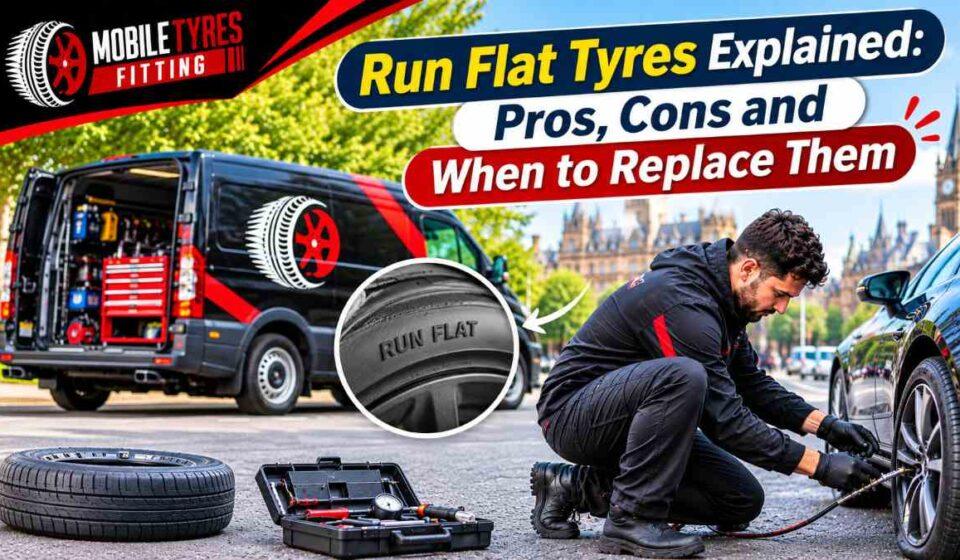
Look at the sidewall. Common markings include RFT, ROF, ZP, DSST or SSR, depending on the manufacturer. Your owner’s manual will also confirm it. Many cars fitted with run flats have no spare wheel, which is often the first clue.
The Pros of Run Flat Tyres
You Can Keep Moving After a Puncture
The main benefit is mobility. You don’t need to change a wheel on a hard shoulder or a dark country road, which is a real safety advantage on motorways and in bad weather.
Better Control During Sudden Pressure Loss
Because the sidewall stays supported, the tyre is less likely to collapse suddenly. That can help you stay in control if you lose pressure at speed.
More Boot Space and Less Weight
Without a spare wheel and jack, manufacturers can free up boot space or save weight. It’s a small benefit, but a practical one.
The Cons of Run Flat Tyres
A Firmer Ride
The stiffer sidewalls can make a car feel harsher over potholes and speed bumps. Some drivers barely notice. Others find it uncomfortable, especially on rough roads.
Higher Cost
Run flats typically cost more than standard tyres of the same size. Over the life of a car, that adds up, and it’s worth factoring in when you’re comparing options.
Repair Limitations
This is the one that catches people out. Many manufacturers advise against repairing run flats, particularly if the tyre has been driven on while deflated. The damage inside the sidewall can be invisible from outside. If your tyre has been run flat for any distance, treat it as a candidate for replacement and have it inspected by a professional.
You Need a Working Pressure Monitor
Run flats can feel normal even when they’ve lost air, which is why cars fitted with them usually have a tyre pressure monitoring system. If that warning light comes on, don’t ignore it. Slow down, drive gently and get the tyre checked.
When Should You Replace Run Flat Tyres?
There are a few clear triggers.
- After driving on them flat. If you’ve travelled any significant distance with no air, the internal structure may be compromised, even if the tyre looks fine.
- When the tread is low. The legal minimum tread depth in the UK is 1.6mm across the central three-quarters of the tyre. Many experts recommend replacing at around 3mm, as wet grip drops noticeably before the legal limit. Check with a depth gauge or the 20p coin test.
- When you spot sidewall damage. Cuts, bulges and cracking are all red flags. Sidewall damage on any tyre is a safety issue, and on a run flat it can be especially serious.
- When the tyre is ageing. Rubber hardens over time. Many manufacturers suggest having tyres inspected regularly once they’re around five years old, and considering replacement at around ten years, whatever the tread looks like. Check the four-digit date code on the sidewall.
- When the pressure warning keeps returning. Repeated warnings can point to a slow leak or damaged valve. Don’t keep topping up and hoping for the best.
Can You Swap Run Flats for Standard Tyres?
Sometimes, but it isn’t always straightforward. Cars designed around run flats may have suspension tuned for them, and with no spare on board, you’d need a way to deal with a puncture, such as a repair kit or space-saver. Mixing run flat and standard tyres on the same axle is generally discouraged.
Before making a change, check your handbook and speak with a qualified tyre fitter or your vehicle manufacturer. The right answer depends on your car.
Practical Tips for Looking After Run Flats
- Check pressures monthly. Do it when the tyres are cold, and use the figures in your handbook or on the door frame.
- Respond to warnings promptly. Reduced speed and a gentle driving style matter if you’ve lost pressure.
- Inspect the sidewalls. Look for scuffs, cuts and bulges after any kerb strike or pothole hit.
- Keep to the limits. Don’t exceed the speed and distance recommended by the manufacturer after a puncture.
- Replace in the right way. Fitting the correct size, speed rating and load index matters for safety.
What Happens If You Get a Puncture Away From Home?
Run flats give you time, not unlimited freedom. Once you’ve pulled over safely or reached a safe spot, the next step is to arrange help rather than carry on for the sake of it.
If you’re stuck, mobile services can reach you at home, work or the roadside, which saves a tow. For instance, 24hrs Mobile Tyres Fitting can come to your location to assess the damage. Whether the tyre can be saved or needs swapping, a proper inspection comes first. This is especially important with run flats, because internal damage isn’t always visible.
If a replacement is needed, specialist run-flat tyre fitting ensures the correct tyre is matched to your vehicle and fitted properly, including resetting the pressure monitoring system where required.
Are Run Flat Tyres Worth It?
It depends on how you drive and what you value. If you cover lots of motorway miles, drive alone at night or want the reassurance of being able to keep moving, run flats make sense. If you prioritise ride comfort and lower running costs, standard tyres with a repair kit or spare might suit you better.
There’s no universal right answer. What matters is understanding the trade-offs and maintaining whichever tyres you choose.
Final Thoughts
Run flat tyres offer genuine safety and convenience advantages, but they also cost more, ride more firmly and are often harder to repair. Check your pressures, respond to warnings and replace them promptly if they’ve been driven flat, are worn or show sidewall damage. Treat them as a safety feature that still needs looking after, and they’ll do their job when it matters most.