







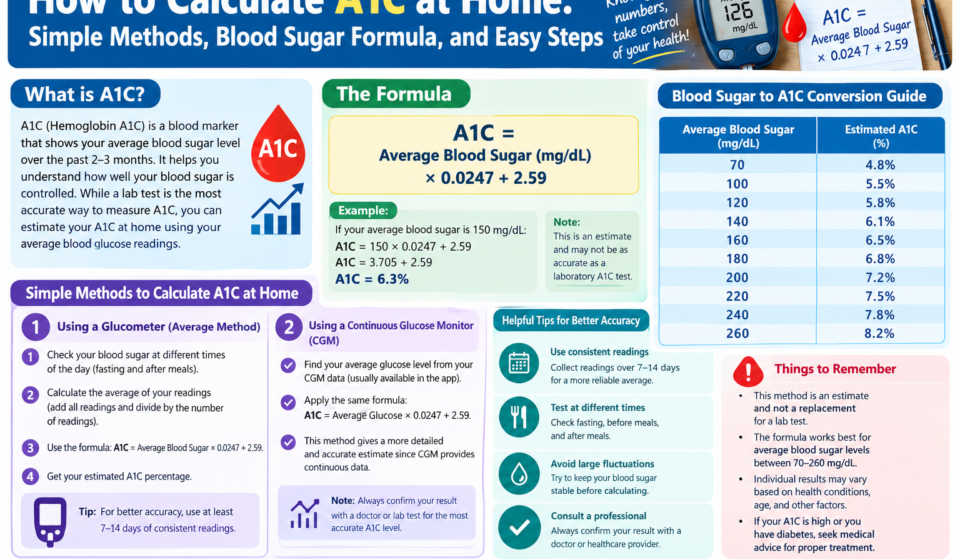

Understanding your blood sugar levels is an important part of maintaining good health. One useful measurement for monitoring long-term blood glucose is Hemoglobin A1C. It shows your average blood sugar levels over approximately the past two to three months.
Many people wonder how to calculate A1C at home without visiting a laboratory. Although you cannot accurately measure your actual A1C percentage using a regular glucose meter alone, you can estimate it using your average blood sugar readings.
In this guide, you will learn how to calculate A1C at home, understand the conversion formula, use a blood glucose meter, and interpret your estimated results.
What Is A1C and Why Is It Important?
A1C, also called HbA1c or glycated hemoglobin, is a blood test that measures the percentage of hemoglobin in red blood cells that has glucose attached to it.
Hemoglobin is a protein found in red blood cells that carries oxygen throughout the body. When glucose circulates in your bloodstream, some of it attaches to hemoglobin.
Since red blood cells typically live for around three months, an A1C test provides an overview of your average blood sugar levels during that period.
A1C is important because it helps people and healthcare professionals:
-
Monitor long-term blood sugar levels.
-
Identify possible diabetes or prediabetes.
-
Evaluate diabetes management.
-
Understand whether treatment is working.
-
Make informed lifestyle and healthcare decisions.
How to Calculate A1C at Home Using Blood Sugar Readings
You can estimate your A1C at home by collecting regular blood glucose readings and calculating your average blood sugar level.
For this method, you will need:
-
A blood glucose meter or glucometer.
-
Test strips and a lancet.
-
A notebook or mobile app to record readings.
-
A calculator.
Follow these simple steps:
Step 1: Measure Your Blood Sugar Regularly
Check your blood glucose using a glucometer. Depending on your healthcare provider’s recommendations, you may need to check your levels before meals, after meals, or at other times during the day.
Step 2: Record Your Readings
Write down your blood sugar readings consistently. Try to collect measurements at different times so your records represent more than just fasting glucose.
Step 3: Calculate Your Average Blood Sugar
Add all your recorded glucose readings and divide the total by the number of readings.
For example:
-
Reading 1: 110 mg/dL
-
Reading 2: 125 mg/dL
-
Reading 3: 140 mg/dL
-
Reading 4: 135 mg/dL
Total = 510 mg/dL
Average = 510 ÷ 4 = 127.5 mg/dL
Step 4: Use the A1C Conversion Formula
Once you know your estimated average glucose, you can use the following formula to estimate your A1C percentage.
A1C Calculation Formula From Average Blood Sugar
The commonly used estimated average glucose (eAG) conversion formula is:
Here:
-
A1C = Estimated hemoglobin A1C percentage.
-
eAG = Average blood glucose in mg/dL.
-
28.7 and 46.7 = Values used in the standard conversion equation.
Example calculation:
Suppose your average blood glucose is 127.5 mg/dL.
Your estimated A1C is approximately 6.1%.
Remember that this is only a mathematical estimate. It does not replace an actual laboratory A1C test.
Estimated Average Blood Sugar to A1C Conversion Chart
The following chart helps you understand the relationship between average blood glucose and estimated A1C levels.
| Average Blood Sugar (mg/dL) | Estimated A1C |
|---|---|
| 97 | 5.0% |
| 114 | 5.6% |
| 126 | 6.0% |
| 140 | 6.5% |
| 154 | 7.0% |
| 169 | 7.5% |
| 183 | 8.0% |
| 197 | 8.5% |
| 212 | 9.0% |
| 226 | 9.5% |
| 240 | 10.0% |
These values are approximate and are based on the standard eAG conversion relationship.
What Are the Normal A1C Levels?
Understanding your A1C results can help you recognize different blood sugar categories.
According to commonly used diagnostic guidelines, A1C levels are classified as follows:
| A1C Percentage | Category |
|---|---|
| Below 5.7% | Normal |
| 5.7%–6.4% | Prediabetes |
| 6.5% or higher | Diabetes range |
An A1C result of 6.5% or higher may indicate diabetes, but diagnosis generally requires confirmation with appropriate laboratory testing unless specific clinical circumstances apply.
For many nonpregnant adults with diabetes, an A1C target below 7% is commonly recommended. However, individual targets can vary depending on age, health conditions, medications, and other factors.
Can You Test Your A1C at Home?
Yes. Home A1C testing kits are available that allow you to collect a small blood sample and send it to a laboratory or use an approved home-testing device.
There are two different approaches:
1. Home A1C Testing Kits
These kits measure your actual HbA1c percentage using a blood sample. Some require sending the sample to a laboratory, while others provide results using a testing device.
2. Glucometer-Based A1C Estimation
A regular glucose meter measures your blood sugar at a particular moment. You can use multiple readings to estimate your average glucose and calculate an approximate A1C.
However, this method is less accurate because occasional glucose readings may not represent your entire three-month blood sugar pattern.
Tips for Getting a More Reliable A1C Estimate
If you want to calculate A1C at home, consider these helpful practices:
-
Record blood sugar readings consistently.
-
Include fasting and after-meal measurements when recommended.
-
Avoid calculating your average using only one or two readings.
-
Use a reliable glucose meter.
-
Keep a record of your daily glucose levels.
-
Discuss unusual readings with your healthcare provider.
-
Get a laboratory A1C test when recommended.
Certain conditions, including anemia, recent blood loss, kidney disease, and some hemoglobin variants, can affect the accuracy of A1C results. This is another reason why home estimates should be interpreted carefully.
Conclusion
Learning how to calculate A1C at home can help you understand the relationship between average blood sugar and long-term glucose control. By recording regular glucose readings, calculating your average, and applying the A1C conversion formula, you can estimate your A1C percentage.
However, a glucometer cannot directly measure hemoglobin A1C. For an accurate result, use a validated A1C testing method and consult your healthcare professional. Regular monitoring, balanced nutrition, physical activity, and appropriate medical care can help you maintain healthier blood sugar levels.