





Lead scoring used to be a points game. A visit to the pricing page earned five points, a job title earned ten, and anything above fifty went to sales. It worked for a while, but buyers now leave far more signals than a simple point system can read, and reps feel the gap every day.
AI-ready CRM developers are closing that gap. They build scoring that learns from real outcomes and updates itself, so reps spend their time on the leads most likely to buy. This guide explains what is changing in 2027, what these developers build, and how to find the right one.
Why Traditional Lead Scoring Falls Short
Rule-based scoring depends on someone guessing which actions matter. Those guesses are rarely tested against actual wins and losses, so the model drifts away from reality. A lead can score high because they opened five emails, while a quieter buyer with a real budget sits unnoticed.
Static scores also go stale. A prospect who was cold last month may be active today, but the number does not change until someone edits the rules. Data lives in separate tools, so web activity, support tickets, and past purchases rarely feed one score. The result is a ranked list that sales staff stop trusting, and a CRM that quietly loses its value.
How AI-Ready CRM Developers Are Changing Lead Scoring
An AI-ready developer treats scoring as a living system instead of a one-time setup. They study your closed deals, find the patterns behind them, and train a model that ranks new leads by how closely they match what actually converted. Then they wire that model into your workflows, so a high score triggers assignment, a reminder, or a drafted email without anyone clicking.
This takes both CRM and AI skill. A pure data scientist may not know how to place a score inside a pipeline, and a standard CRM developer may not know how to train or monitor a model. That is why a growing number of sales leaders now hire CRM developer specialists who handle both sides, so the scoring logic, the data, and the daily workflow are built to work together from the start.
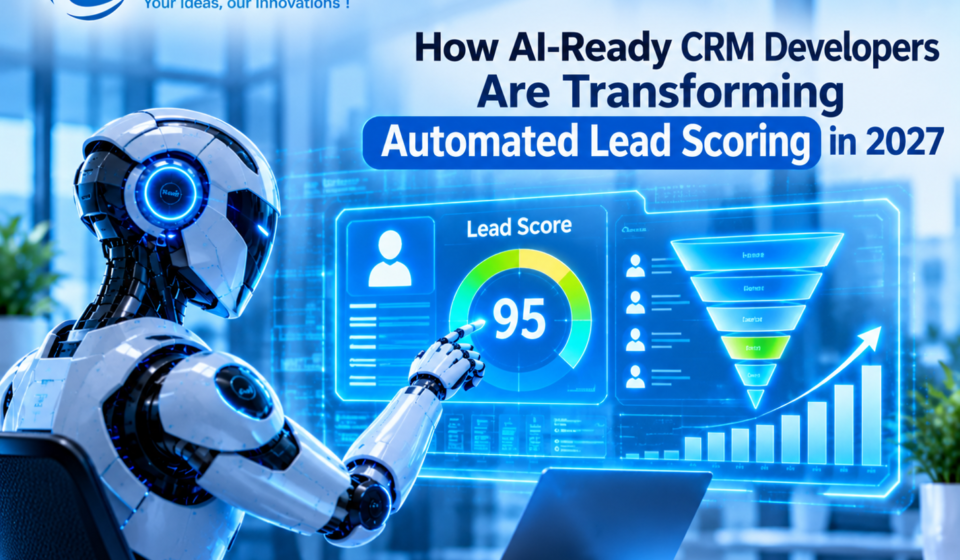
In 2027, the shift is from scores that sit in a field to scores that drive action. The model re-ranks leads as new activity arrives, explains why a lead scored high, and passes the best ones to the right rep within minutes.
Lead Scoring Capabilities These Developers Build
The best scoring systems go well beyond a single number. AI helps by combining numerous signals at once and updating them continuously, which no manual rule set can match. Here is what a capable developer usually delivers.
Predictive scoring. Models trained on your own pipeline data rank leads by their likelihood to convert, instead of relying on guessed point values.
Real-time re-scoring. Scores update as leads open emails, visit pages, or reply, so the ranking always reflects the latest behavior.
Explainable scores. Reps see the reasons behind a score, such as recent pricing-page visits or a matching company profile, which builds trust in the model.
Smart routing. High-scoring leads go straight to the right rep by region, product, or workload, with no delay.
Generative follow-ups. The CRM drafts personalized emails and call summaries for each lead, so reps respond faster and with better context.
Churn and upsell scoring. The same approach flags existing customers who may leave or who are ready to buy more.
Platform-Native AI and Custom Models
Most employers do not need to start from scratch. Platforms already include scoring tools, and a skilled developer configures them properly. That includes Salesforce Einstein and Agentforce, Microsoft Copilot, Zoho Zia, and HubSpot Breeze, each with its own strengths and limits.
When built-in tools are not enough, developers connect outside models such as OpenAI, Claude, or Gemini through secure APIs, keeping your customer data private. For assistants that qualify leads, ask questions, and update records on their own, AI agent development takes scoring a step further by letting software act on the score instead of only reporting it. A good developer explains which route fits your data volume and budget instead of pushing one tool.
The Data Behind Accurate Lead Scoring
An AI model is only as good as the records it learns from. Before any scoring goes live, a careful developer audits your data and fixes the gaps. That usually covers several points.
- A clear history of won and lost deals, since the model learns from outcomes
- Clean, deduplicated contact and company records
- Connected sources, such as web activity, email, support, and billing data
- Consistent field formats and naming across tools
- Proper consent and privacy handling for customer data
Skipping this step is the most common reason AI scoring disappoints. If the inputs are messy, the scores will be too, no matter how advanced the model is.
What to Check Before You Hire
Not every developer who mentions AI can build reliable scoring. A short, structured check helps you separate real experience from buzzwords. Ask for proof on each point below, and run a small paid task before committing to a larger project.
- Live AI features they have shipped inside a CRM, with results
- Hands-on work with your platform, such as Salesforce, Zoho, HubSpot, Creatio, Dynamics 365, or Odoo
- Experience with APIs, data modeling, and integrations
- A method for testing model accuracy and tracking it over time
- Guardrails and human review to stop wrong or made-up outputs
- Security practices, including role-based access and safe handling of data sent to AI models
Provider quality matters too. EmizenTech, for example, shares three to five vetted profiles within 24 hours and lets you interview each developer before you approve the hire. Whichever route you take, look for a trial period, free replacement, and full ownership of the code.
Mistakes to Avoid with AI Lead Scoring
AI scoring can transform a pipeline, but only when it is set up with care. Most disappointing results trace back to the same few errors. Reviewing them early saves months of rework and keeps staff confidence high.
Launching on messy data. Clean the records first, or the model will learn the wrong patterns.
Treating the score as final. Keep human review in the loop, especially for high-value leads.
Never retraining the model. Buyer behavior changes, so scores need regular checks and updates.
Hiding the reasoning. If reps cannot see why a lead scored high, they will ignore the number.
Conclusion
Automated lead scoring is moving from guessed points to learning systems that rank, explain, and act in real time. The results depend on the person building them, so look for developers who combine CRM depth with proven AI work, and insist on clean data, testing, and human oversight. If you are ready to turn your pipeline into a smarter, self-updating system, EmizenTech can pair you with developers who build scoring that your sales staff will trust and use.
Frequently Asked Questions
1. What is AI lead scoring in a CRM?
AI lead scoring uses machine learning to rank leads by how likely they are to convert. It learns from your past wins and losses, tracks behavior in real time, and updates scores automatically instead of relying on fixed point rules.
2. How is AI lead scoring different from rule-based scoring?
Rule-based scoring uses points that someone sets by hand and rarely updates. AI scoring finds patterns in real data, adjusts as behavior changes, and can explain why a lead ranks high.
3. What data do I need for accurate AI lead scoring?
You need a history of won and lost deals, clean contact and company records, and connected sources such as web activity, email, and support data. Consent and privacy handling matter as well.
4. Can AI lead scoring be added to my existing CRM?
Yes. Developers can configure built-in tools like Einstein, Zia, or Breeze, or connect custom models through APIs, without replacing Salesforce, Zoho, HubSpot, Creatio, Dynamics 365, or Odoo.
5. How quickly can I hire an AI-ready CRM developer?
With a provider that offers fast onboarding, a vetted shortlist can arrive within 24 hours and a developer can start within about 48 hours, once requirements are shared.