





The curved sides of a pillow box give it a soft silhouette that reads as a gift rather than a shipping carton. The format closes with overlapping curved flaps at each end, so it needs no glue or tape, and it assembles from flat in seconds. Pillow Boxes work best for products under roughly 300 g, small enough to fit in a hand and sold on presentation, such as jewelry, soap, candles, and confectionery. Heavier items can force the end tucks open, so the format should be matched to the contents rather than chosen for appearance alone.
Which Board Weight Holds the Curve?
The curved body that makes the format charming is the same curve that cracks heavy board and collapses light board, so the workable window is narrower than most buyers expect. Standard favor sizes generally run between 250 gsm and 350 gsm, and many suppliers use 280 to 350 gsm chromo or SBS boards. A board that is too thin dents in a bag or a shipping carton, while one that is too thick makes the end flaps difficult to tuck and can crack along the fold. The board should be specified around the actual product weight and the depth of the curve.
- Tucked end flaps close without adhesive or tape
- A 250 to 350 gsm board holds the curve without cracking.
- Matte finishes support foil stamping and embossing.
- Uncoated surfaces accept handwritten gift notes.
How Does Printing Behave on a Curved Surface?
Large flat graphics can distort when they wrap around a curve, so designs with centered motifs or repeating patterns are usually more resilient. Text laid down on the flattest part of the panel will be readable, however text that runs across the curve may appear stretched. Checking a printed sample on the assembled box rather than on a flat sheet catches distortion before a full run. For short seasonal runs digital is the best choice. For large volumes with fine detail offset is the best choice.
Where Do Inserts and Windows Fit?
A window cutout shows the product without opening the box, which suits jewelry and confectionery. An inner insert holds the item in place and stops it from sliding toward the curved ends, where the tucked flaps offer less support. For food items, a food-safe liner or a coated board supports direct contact, and a grease-resistant layer protects the printed surface from oil. The usable cavity narrows toward both ends, so the product should sit in the widest part of the package rather than pushing into the closure zones.
Which Formats Complement a Pillow Box?
A gable box can hold several pillow boxes as a bundled gift set, and a sleeve box adds a second branding surface around the curve. A belly band or ribbon tied around the middle reinforces the gift feel without fighting the shape. Pillow boxes also store and ship flat, which keeps freight costs low before assembly. The format pairs naturally with other small-format cartons that share the same board and print system.
Custom Tuck Boxes for Reclosable Retail Cartons
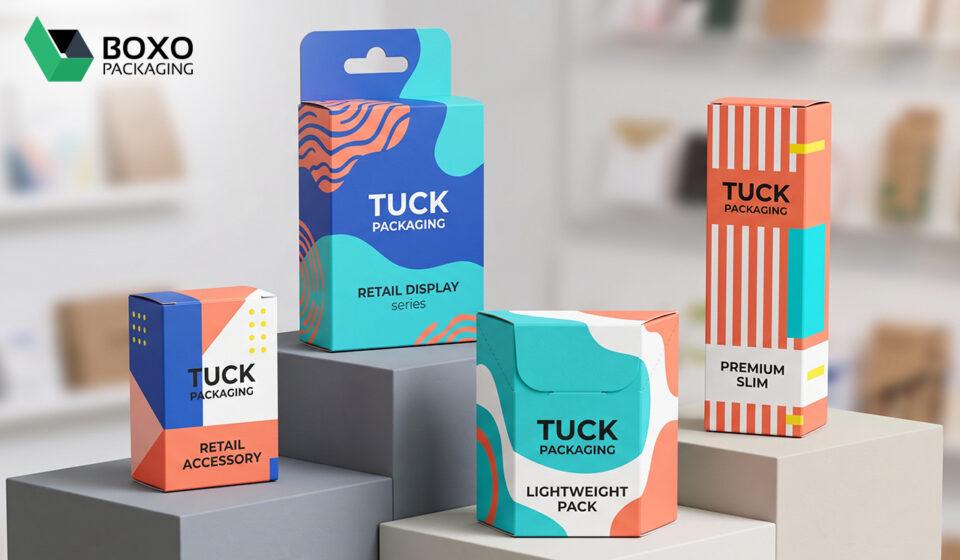
A tuck box closes with a flap that folds into a slot on the opposite panel, so the carton can be opened and closed repeatedly without losing its shape. That mechanism makes Custom Tuck Boxes a common choice for products that customers inspect before buying and for items used over several sittings. The design uses a single die-cut blank, which keeps production straightforward. A glue flap holds the body together while the tuck flaps do the closing work at both ends.
How Do Straight and Reverse Tuck Ends Differ?
The two common configurations place the tuck flaps in different positions. In a straight tuck end, both flaps fold from the same panel, which creates a slightly thicker stack at the tuck area and gives a cleaner front panel. In a reverse tuck end, the flaps fold from opposite sides, which distributes board thickness more evenly and keeps the flap under tension so it stays closed more securely on the shelf. Reverse tuck also frees the front panel for full-bleed artwork.
- Straight tuck ends present clean edges on two faces.
- Reverse tuck ends free the front panel for full-bleed graphics.
- Reverse tuck distributes board thickness more evenly.
- Single-blank construction reduces material waste.
- Which Board Weights and Base Styles Hold Up?
Typical board weights for tuck boxes run from about 300 to 400 gsm, with 14 pt to 18 pt common in North American specifications. A lightweight carton under 300 gsm suits straight tuck ends and high-speed automated lines, while a heavier board benefits from a reverse tuck or a reinforced base. A lock-bottom or auto-lock base holds more weight than a simple tuck base and assembles faster on a packing line, which is relevant for heavier products such as jars or small bottles.
Where Does the Friction Tuck Reach Its Limits?
The friction tuck has boundaries. Dense products above roughly a pound and a half can work the bottom flap open during transit unless a lock-bottom or glue assist is added. Tall cartons place more strain on the tuck flaps, since the side panels flex under load. For heavy or fragile items, a corrugated mailer or a crash-lock carton is often the safer structure. Testing a filled box, rather than an empty one, shows whether the flaps stay closed when the carton is lifted and carried.
Which Products Suit a Tuck Closure?
Cosmetics, soap, candy, jewelry, tea, supplements, and small electronics all work with this closure because they are light and often inspected before purchase. Products that need a premium unboxing moment may find the tuck format too plain, since it reads as a retail shelf carton rather than a gift package. Matching the closure to the product’s weight and to the way customers will handle it keeps the format doing what it does best. Boxo Packaging produces custom tuck boxes and pillow formats with board and closure matched to the product.