







A large corner cabinet can hold several pans and still make it hard to reach the one you need. The opening may be narrow, or a bulky pot at the front may block everything behind it. You notice the difference when dinner is on the stove and you need a lid right away.
I’d start by choosing what you want the corner to hold. A stack of mixing bowls needs a different opening from a wide roasting pan. How often you use each item also matters. A pan you reach for twice a year can sit farther back than the saucepan you use every night.
If you’re updating an L-shaped or U-shaped kitchen in Orland Park, IL, look at both walls that meet at the corner. The cabinet you choose can change how much room you have for drawers, how far a nearby door opens, and where you put everyday cookware.
Measure What Has to Fit Through the Opening
When comparing corner kitchen cabinets, measure the items you want to store and compare them with the clear opening. Include handles, lids, and anything that sticks out. A roasting pan can fit on a shelf and still be awkward to get through the door.
Think about the movement it takes to put the item away. Can you slide it straight in, or do you have to turn it while bending down? For heavy cookware, that extra movement can make a cabinet frustrating. If you’re replacing an existing unit, notice which items you already avoid putting there. That tells you what the new design needs to fix.
Compare How Each Corner Cabinet Opens
A blind corner cabinet has an opening on one side, with part of the storage extending behind the adjoining cabinet run. A fixed shelf can work for occasional items if you can reach them. Compatible corner cabinet pull-outs bring trays toward the opening, though the hardware takes up some space and needs room to move.
A Lazy Susan cabinet uses rotating shelves to bring items around to the front. It can suit bowls, containers, and other pieces that fit the tray. Check the usable tray shape and weight rating, especially if you plan to store cookware. Wide rectangular items may fit better on a straight shelf.
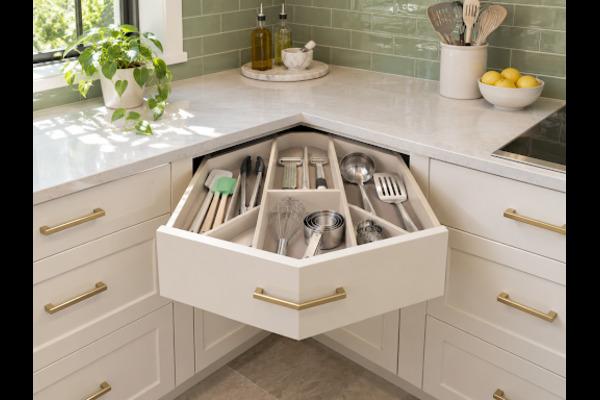
A diagonal corner cabinet puts the door across the corner at an angle. This gives you a direct view into the cabinet, but items at the back may still be hard to reach. Try opening a sample and reaching for something near the rear before deciding whether the layout feels comfortable.
Decide What Belongs in the Cabinets Next to It
The corner is only one part of the layout. Compare two drawings that show the corner and the cabinets on either side. If a larger corner unit leaves room for only a narrow drawer bank, check whether that trade gives you better storage for the things you use most.
For example, base cabinets with drawers may be a better home for everyday pans and lids, while the corner holds serving bowls and baking dishes. If the corner is the only practical spot for frequently used items, a rotating shelf or pull-out may be worth the space it takes. Compare both plans using the same cookware so you can see where each piece would go.
Check the Layout With Doors and Drawers Open
Ask for a drawing that shows how the corner door, neighboring drawers, and nearby appliances open. Check the handles too. A door may clear the cabinet beside it while the pull catches on an adjoining handle. A pull-out tray may also need the door to swing farther than you expect.
If the dishwasher sits beside the corner, picture unloading it while someone else reaches for a mixing bowl. Could both people use the space comfortably? Depending on the layout, a filler strip, a different hinge, or a change to the neighboring cabinet width may help. Confirm the solution before the cabinet order is final.
Try the Hardware With Your Storage in Mind
At a showroom, open the door fully and operate the tray or shelf the way you would at home. Notice where you have to grip, bend, or reach. Then ask for the usable tray dimensions and weight limit for the exact fitting on your quote. If you’re comparing cabinet layouts in person, call ahead to ask which corner units are on display at the cabinet showroom in Orland Park, IL.
Final Thoughts
Before ordering a corner cabinet, pick three things you expect to store there and check how each one goes in and comes out. Then look at the space left for drawers on both walls and test the layout with nearby doors open. Those checks can help you decide whether the corner needs a pull-out, a rotating shelf, or a simple place for the serving pieces you use less often.
Frequently Asked Questions
Can I add a pull-out to an existing blind corner cabinet?
Possibly. Measure the clear door opening, interior width and depth, and space around the hinges. Compare those measurements with the organizer’s installation requirements and check its weight rating against what you plan to store.
What should I store in a corner cabinet with fixed shelves?
Consider serving bowls, bakeware, or other items you use occasionally and can lift through the opening comfortably. Keep the heavier pieces near the front so you can reach them without moving several things first.
Is a Lazy Susan useful for storing pots and pans?
It can work for cookware that fits the tray and stays within its weight limit. Measure across the handles as well as the pot itself, and check whether the tray can turn without anything catching.