





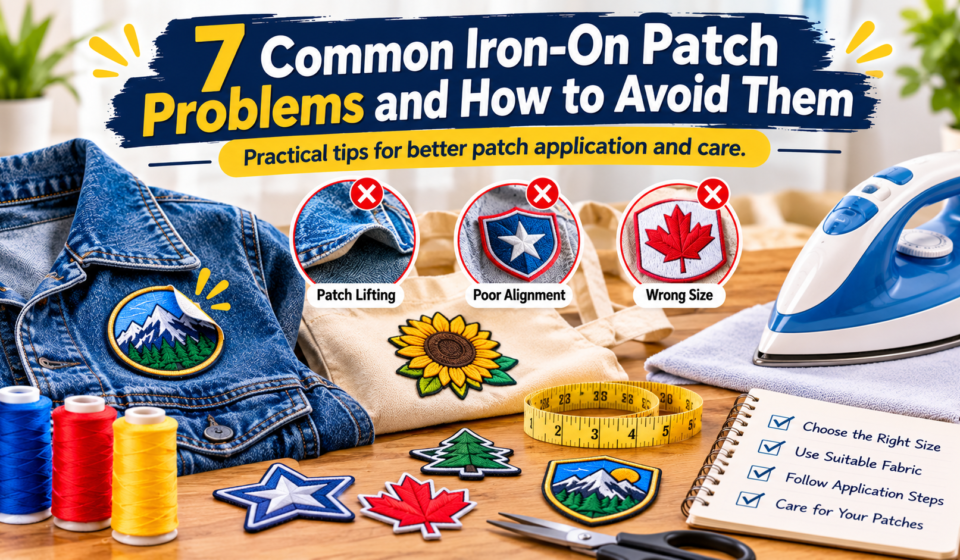

A patch can turn a plain jacket into a personal statement, give a school uniform a recognizable emblem or help a club create a shared identity. But applying one is not always as simple as placing it on fabric and using a household iron. Customers exploring Iron On Patches Canada often have practical questions: Why does a patch start peeling? Which fabrics can handle heat? How long should it be pressed? Can it be washed afterwards? These questions matter because a small mistake during selection or application can affect both the garment and the finished design. Whether you are customizing a denim jacket, preparing team clothing, decorating a tote bag or adding a logo to merchandise, understanding common patch problems can help you get a better result. Here are seven issues worth checking before you begin.
- The Patch Does Not Stick Properly
One of the most frustrating problems is finding that a patch does not attach securely. Sometimes the middle sticks while the corners remain loose. In other cases, the entire patch lifts shortly after application.
Possible reasons include:
- The fabric is not suitable for heat-activated adhesive.
- The garment has a coating or finish that prevents proper bonding.
- The required temperature or pressing time was not followed.
- The iron did not apply even pressure across the patch.
- The fabric or patch was damp or dirty.
How to avoid it: Check the garment care label and the patch supplier’s instructions first. Make sure the surface is clean and dry. Follow the recommended temperature, pressure and application time. Do not assume every patch uses identical settings.
If the fabric cannot tolerate heat, ask whether a sew-on backing is available.
- The Fabric Gets Damaged During Application
Not every garment is designed to withstand the heat needed for an iron-on adhesive. Synthetic blends, delicate materials and coated fabrics can be especially sensitive.
Excessive heat may cause:
- Discolouration or shiny marks.
- Fabric shrinkage or distortion.
- Damage to printed designs.
- Melting or weakening of synthetic fibres.
How to avoid it: Read the clothing label before applying a patch. If the garment has a low heat limit or says not to iron, do not apply high heat directly. A pressing cloth may help protect some fabrics, but it does not make an unsuitable material safe for every iron-on product.
When in doubt, choose a sew-on patch or ask the manufacturer for a suitable alternative.
- The Patch Looks Too Large or Too Small
A design may look perfect on a computer screen but appear unbalanced once attached to clothing. This usually happens when the patch dimensions are selected without measuring the available space.
For example, a large logo may cover a pocket or interfere with a jacket seam. A very small patch may make text or fine artwork difficult to recognize.
How to avoid it:
- Measure the area where the patch will be placed.
- Consider the garment’s seams, pockets, buttons and zippers.
- Check whether the design includes small lettering.
- Compare the proposed dimensions with the garment itself.
- Request a digital proof or size preview if available.
For uniforms or group clothing, test the design on one garment before ordering a larger quantity.
- Small Text and Detailed Artwork Become Difficult to Read
A patch has limited space. When a complicated design is reduced to a small size, thin lines, tiny letters and closely packed details may lose clarity.
This can be a problem for company logos, school crests, club names and designs containing slogans.
How to avoid it: Start with clear, high-resolution artwork. Avoid unnecessary decorative details and use lettering that remains readable at the intended size. Ask the supplier to review the design before production.
Different production methods also handle details differently. Woven patches may be suitable for some fine lettering, while embroidered patches provide a textured stitched appearance. Printed patches may be worth considering for complex colour artwork. The best option depends on the actual design and available production specifications.
- The Patch Starts Peeling After Washing
A patch that appears secure immediately after application may begin lifting after repeated washing or regular use. This can happen because of unsuitable fabric, incomplete bonding, friction or care methods that do not match the product’s requirements.
How to reduce the risk:
- Follow the patch supplier’s washing instructions.
- Turn the garment inside out before washing when practical.
- Use the recommended washing temperature.
- Avoid aggressive scrubbing around the patch.
- Follow the garment’s drying instructions.
- Check the patch edges periodically.
No patch should be assumed to withstand every washing condition. If the edges begin lifting, avoid pulling them further. Ask the supplier whether the particular backing can be reapplied safely or whether stitching is recommended.
- The Patch Is Placed Crooked or in the Wrong Position
Even a well-made patch can look untidy if it is attached at an angle or positioned too close to a seam.
This problem is common when customers rush the application or try to position a patch while already pressing it.
How to avoid it: Place the patch on the garment before applying heat. Check its alignment from several angles. For symmetrical designs, use seams or garment edges as visual guides. You can also measure the distance from the collar, pocket or sleeve edge to keep placement consistent.
For a group order, create a simple placement guide so every garment has the patch in the same position.
- The Wrong Backing Is Selected for the Garment
Iron-on backing is convenient for compatible materials, but it is not automatically the best choice for every item.
A lightweight shirt, a delicate fabric, a structured cap and a heavy canvas bag all have different surfaces and construction. A method that works on one may not work well on another.
Understand the main options:
- Iron-on backing: Uses heat-activated adhesive and is convenient for compatible fabrics.
- Sew-on backing: Attaches through stitching and can be useful for materials that should not be exposed to heat.
- Iron-on with additional stitching: May be considered for some frequently used garments when the patch and fabric allow it.
Before choosing, explain to the supplier what item the patch will be attached to and how often it will be used.
How to Choose a Patch Before You Order
Many application problems can be prevented before production begins. A few basic checks can make the selection process easier.
Check the garment material
Identify whether the item is cotton, denim, canvas, polyester or another fabric. Check its care label and heat limitations.
Select the right design style
Consider whether your artwork needs the raised texture of embroidery, the detail of weaving or the colour flexibility of printing.
Confirm the dimensions
Measure the intended placement area and check that any lettering remains readable.
Ask about backing options
Explain how the garment will be used and ask which attachment method is appropriate.
Review the artwork and order details
Confirm colours, dimensions, quantity, production timeline and any available proofing process before approving the order.
These checks are useful for individual clothing projects as well as larger orders for schools, clothing brands, sports clubs, community organizations and event teams.
Frequently Asked Questions
- Why is my iron-on patch not sticking to my jacket?
The fabric may be unsuitable, the surface may be coated, or the recommended heat and pressure may not have been applied correctly. Check the garment label and the patch instructions before trying again.
- Can I use iron-on patches on polyester?
It depends on the specific polyester fabric and patch backing. Some synthetic materials are heat-sensitive. Check the garment’s care instructions and ask the supplier for the recommended application method.
- Can I put an iron-on patch on a denim jacket?
Denim is commonly used for iron-on patches, but the jacket’s finish, lining and care instructions still matter. Follow the supplier’s instructions for the particular patch.
- How do I stop the corners of a patch from peeling?
Start by making sure the fabric is suitable and the patch is applied according to its instructions. Follow the recommended washing and drying guidance. If peeling occurs, ask the supplier whether reapplication or additional stitching is appropriate.
- Can I wash clothing immediately after applying a patch?
Do not assume it is ready for washing immediately. Follow the cooling, setting and care instructions supplied with the patch. Different adhesive systems may have different requirements.
- Are embroidered patches suitable for small logos?
They can work well for many logos, but very small lettering and intricate details may need simplification. Ask for an artwork review at the intended patch size.
- Is sew-on backing better for delicate clothing?
It can be a better option when a garment cannot tolerate the heat required for iron-on adhesive. However, the fabric should also be suitable for stitching.
- Can I apply patches to bags and caps?
Some fabric bags and caps can accommodate patches, but their shape, thickness and material affect the attachment method. Curved or structured surfaces may be more difficult to press evenly.
- What should I provide when ordering custom patches?
Prepare your design or logo, preferred dimensions, colours, quantity, intended garment and backing preference. Also explain whether the patch will be used on everyday clothing, uniforms or accessories.
- Should I choose iron-on or sew-on patches for uniforms?
Consider the uniform’s fabric, washing frequency and daily use. Iron-on backing may suit compatible materials, while sew-on or additional stitching may be more appropriate for some frequently worn garments.
Conclusion
Most patch problems are connected to a few important decisions: selecting a compatible fabric, choosing suitable dimensions, preparing clear artwork and following the correct application instructions. Paying attention to these details can help prevent peeling, fabric damage, poor placement and unclear designs.
A patch should suit both the garment and the reason it is being used. Whether it represents a school, business, sports club, creative project or personal interest, careful selection and proper care make the finished result more practical and presentable.