






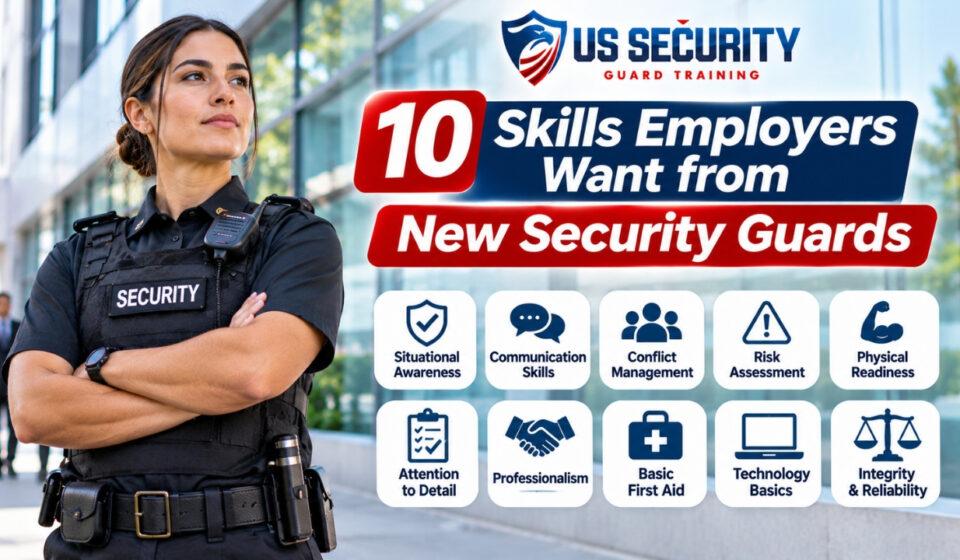

Having a security guard license is just one of the basic requirements for this type of role. Employers seek employees who can communicate effectively and are both reliable and composed. Fortunately, most of the required skills can be acquired and developed.
Below are the key skills most employers are seeking in junior security officers. Alongside information on why each is so important and how to develop it, the guide also outlines the specific training required in California for new guards to undertake prior to commencing work. Apply this information to both your interview preparation and to your own development so that you can become a highly regarded officer.
Why These Skills are Required
Security guard skills can increase both employment prospects and salary. There are around 1.27 million security guard jobs in the USA. Furthermore, in California there were around 199,800 such roles in 2024. This number is expected to increase by roughly 3% in California by 2034. Around 26,420 security guard vacancies are forecast in California between now and then. Nationally, the median salary for a security guard was $38,020 in May 2025. Vacancies frequently occur due to staff leaving, and good, capable officers will therefore tend to be recognised for this. Employers are keen to employ newly qualified security officers that are independent and can resolve issues.
1.Communication
Excellent communication is almost always one of the most sought-after skills in security officers. Officers constantly have to explain information to people – for instance, regarding procedures and directions. They must also effectively communicate with both superiors (via two-way radios) and police personnel, especially in emergency situations. In 2026, 75% of security heads identified communication as a key skill. Speak at an appropriate pace, actively listen to people and use clear, courteous language.
2. Observation
Officers are expected to identify and recognise subtle clues that others overlook. For example, a slightly ajar door, unusual vehicle and/or an anxious person may all indicate an issue. An officer able to detect smoke at an early stage could in fact save an entire building. Officers should avoid using their mobile phones and regularly check their environment. Good observers are also adept at recalling people’s features, clothing and licence plate numbers together with precise timings. To further develop this skill, try to verbally recall details of people and locations on a daily basis.
3. Report Writing
All events – even seemingly minor ones – must be recorded accurately. Information may then be utilised by superiors, insurers and/or the courts. Poor report writing was recognised as a common deficiency in a survey of over 10,000 security officers. Only 42% of officers believed their peers were highly skilled at this. Consequently, good report writers are quickly recognised by both superiors and clients. Good reports should include information relating to the who, what, where, why and how of an event. Stick to factual information and avoid speculation. Reports should also be completed by the end of your shift.
4. De-escalation
It is commonplace for officers to encounter irate, intoxicated and/or emotional individuals. Officers are therefore required to ease situations through effective, composed communication. Officers should remain at a suitable distance from people and present them with straightforward options. As part of California’s current security officer training scheme, 5 hours is devoted to teaching employees how to appropriately apply force. Hence, employers expect new officers to already possess fundamental de-escalation knowledge.
5. Understanding Legally Permitted Activity
Whilst officers are not police personnel, employers wish to ensure that staff comprehend this distinction. Officers must recognise circumstances in which a member of the public can and cannot be arrested. Newly qualified officers also need to be aware of what is legally permissible in terms of searching people, detaining them and using force. Failure to do so could swiftly result in a spurious allegation of wrongful arrest. Poor decisions of this nature can cause both you and your employer to face legal action. Consequently, 100% marks must be achieved on the ‘Power to Arrest’ examination. Frequently review your training documentation and query your superiors regarding any additional local policies that may apply.
6. Customer Service
Many security officers operate within busy public environments including shopping centres, hotels, offices and hospitals. As well as providing security, officers frequently fulfil the roles of welcoming and directing personnel. Officers should therefore display a warm disposition and be approachable in order to ensure the general public feel secure and welcomed. Typically, a security company will endeavour to retain officers who receive good feedback in relation to customer service. Furthermore, good customer service skills can often prevent disputes from arising in the first instance.
7. Reliability and Punctuality
Although seemingly a basic requirement, punctuality is often of paramount importance. Customers are charged for the service provided each and every hour. Where officers are late, properties lack essential security and superiors must then endeavour to address this. Usually, employers prioritise promoting reliable officers over more experienced but less reliable staff. Carefully organise your travel arrangements and establish alternative alert mechanisms. Ideally, aim to arrive 15 minutes before your shift begins. Immediately notify your superior if you will be late due to an emergency.
8. Emergency and First Aid Awareness
Officers frequently arrive at and are often the first at scenes of emergencies such as fire, falls and fights. Thus, employers value officers that are well versed in a site’s evacuation procedures, alarm codes and so on. First aid and CPR qualifications also greatly strengthen an officer’s application for numerous positions. Again, these skills enable officers to remain composed and to contribute effectively to situations where others may be panicking. Ensure that you thoroughly understand your site’s emergency procedure during your initial week of employment.
9. Basic Computer Skills
Within today’s world, security officers utilise computers, tablets and mobile phones together with specialist software. Many companies make use of computer programmes to manage patrol points, to document information and to take photographs. Officers are frequently asked to monitor closed circuit television and manage computerised access control. Even some job adverts for security officers list Microsoft Office as a desirable skill. Therefore, having basic computer skills enables officers to work at a wider range of sites and in various roles.
10. Integrity and Sound Judgement
Officers frequently have access to keys, codes and confidential information and valuable items. Employees must therefore be entirely trustworthy, particularly in the absence of supervision. Officers should also be able to decide whether to take action, to observe a situation or to inform someone of it. Alongside communication, sound judgement and problem solving abilities are frequently identified by security heads as highly significant. Acknowledge errors promptly, and always comply with instructions. Never compromise on policies for the sake of friends.
Essential Training for California-based Security Officers
Alongside important skills, there are strict guidelines in California regarding the training that all security officers must undertake. Initially, officers must successfully complete an obligatory 8 hour training programme. This comprises 3 hours on ‘Power to Arrest’, and 5 hours on force. Of the 8 hours, no less than 50% must be delivered face-to-face. Now, one trainer is responsible for both delivering and certifying the whole training programme (as stipulated by SB 652).
How to Develop Your Skills Rapidly
Prepare sample reports for each shift, including on particularly quiet nights.
Query more senior officers regarding how they managed their most challenging telephone calls and most difficult situations.
Undertake a recognised first aid and CPR course.
Verbally describe unfamiliar people and vehicles to further develop your observational capability.
Examine genuine reports to better understand good report writing.
Thoroughly read your post specification and discuss any points that are unclear with your superiors.
Ideally, complete your 32 hours of training earlier than is strictly necessary.
Minor yet regular actions can cumulatively make you a highly desirable employee.
Additional Skills for Higher Earnings
Further skills can assist officers to obtain more highly paid roles and to progress in their careers. For instance, to work in armed roles, officers require a BSIS permit to handle guns and these roles are typically more highly remunerated. Fluency in additional languages is also highly advantageous, particularly within hospital, hotel and busy retail settings. Officers who can motivate and train others are valued by superiors. Likewise, those who excel at report writing often transfer into dispatch and supervisory roles. Certified and experienced officers are frequently highly paid by security guard companies.
How US Training Guard Trains New Security Officers
The US Training Guard supports new officers to efficiently begin their careers. We deliver a 3-part training programme that encompasses all 40 hours of mandatory California security officer training. Students complete the ‘Power to Arrest’ section online and the ‘Use of Force’ element face-to-face. Our online training can be accessed via phones, tablets, laptops and desktop computers, at any time. We also provide Live Scan fingerprinting services at our Southern California facility.
Our tutor, who began his career as a security officer at age 22, has over 12 years’ experience in this field. He has a degree in criminal justice, together with a baton tuition licence and PPO licence. Thus, students benefit from learning from somebody with genuine, on-the-job security experience. Appointments are available for our in-person training sessions, and we cater for students throughout the Southern California region. Graduates are thus fully equipped to confidently commence work for any security guard company.
FAQs
What skills are most sought by employers?
Generally, employers are looking for officers to demonstrate good communication, observational and report writing skills. Integrity and fundamental legal awareness are also nearly universally required.
Do I require work experience to become a security officer?
Not necessarily. Many employers will recruit newly qualified officers who have a security guard card and positive attitudes. Nevertheless, displaying good skills in interviews can expedite your employment prospects.
How long does security officer training last in California?
An overall total of 40 hours is needed. Of these, 32 hours must be undertaken within 6 months. Officers then attend an 8 hour annual refreshment training session.
Is it possible to undertake security guard card training online?
Whilst certain elements of the training (such as ‘Power to Arrest’) can be studied online, a minimum of 50% of the 8 hour training must be face-to-face.
Conclusion
Apart from a guard card and uniform, employers seek much more from security officers. Most commonly, good communication, observation and report writing skills are highly valued. Composed de-escalation, legal awareness and customer service all contribute to maintaining both the safety and satisfaction of clients. Reliable officers, alongside those with emergency response skills, computer skills and integrity, further foster enduring client trust.
Newly qualified officers that successfully acquire these skills are able to attain and progress within more desirable roles. Suitable training is therefore integral to beginning a successful career. At the US Training Guard, we provide all the 40 hours of California security officer training. Our training is a mix of convenient online and practical face-to-face tuition. Register with the US Training Guard today in order to begin your security career and allow our expert tutor to support you in becoming the ideal security officer.