




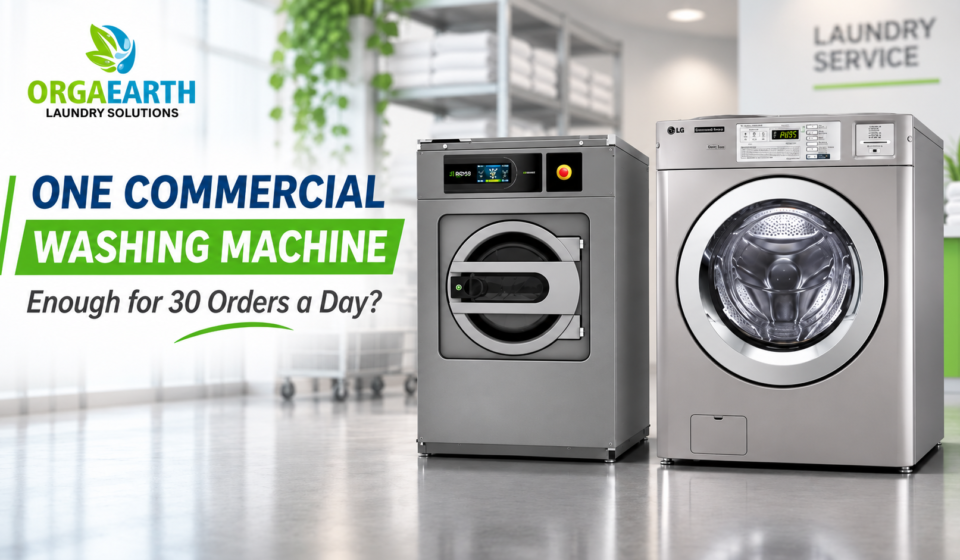

Imagine opening your first laundry shop and receiving 30 customer orders every day. Business is growing, customers are returning, and your investment is beginning to show results.
But there is one problem. Your washing machine is running throughout the day, and new orders keep arriving.
Should you continue with one machine or invest in another?
Choosing the right commercial washing machine is one of the most important decisions when starting a laundry business. Purchasing too much capacity increases initial investment, while insufficient capacity can create delays and affect customer satisfaction.
The answer depends on the weight of each order, washing cycle duration, operating hours, and services offered.
Before purchasing additional equipment, understand how much laundry one machine can realistically process.
Does 30 Orders Mean 30 Washing Loads?
Not necessarily.
A customer order may contain a few shirts, several kilograms of everyday clothing, or bulky household linen.
For example, suppose your shop receives 30 orders daily, with an average weight of 4 kg per order.
Daily laundry volume = 30 × 4 kg = 120 kg
However, if the average order weighs 6 kg, the workload increases to 180 kg.
This difference directly affects the required machine capacity.
Another important consideration is fabric segregation. White garments, dark clothing, delicate fabrics, and heavily soiled items may require separate washing programmes.
Therefore, 30 customer orders cannot automatically be combined into a fixed number of full machine loads.
Track actual garment weight and fabric categories before deciding how many machines your business needs.
How Much Can One Commercial Washing Machine Process Daily?
The daily capacity of a machine depends on its rated load, washing programme, and available operating time.
Consider a hypothetical shop operating a 15 kg commercial washer.
Assume:
- Rated machine capacity: 15 kg
- Average usable load: 12 kg
- Washing cycle: 50 minutes
- Loading and unloading: 10 minutes
- Daily operating time: 8 hours
One complete batch requires approximately 60 minutes.
The machine could theoretically complete eight batches during an eight-hour shift.
Estimated daily washing output = 12 kg × 8 cycles = 96 kg
If your business receives 120 kg daily, this setup would leave approximately 24 kg unprocessed.
These figures are illustrative, not guaranteed performance specifications. Actual throughput depends on the machine model, programme, fabric type, loading requirements, and operational delays.
The calculation also covers washing only. Drying, ironing, and packaging require additional time.
Which Machine Capacity Is Suitable for 30 Daily Orders?
Commercial laundry equipment is available in different capacities, allowing businesses to select machines according to their processing requirements.
The following comparison assumes eight completed cycles daily and an illustrative usable load of 80% of rated capacity.
| Machine Capacity | Assumed Load per Cycle | Daily Washing Output |
| 10 kg | 8 kg | 64 kg |
| 15 kg | 12 kg | 96 kg |
| 20 kg | 16 kg | 128 kg |
| 25 kg | 20 kg | 160 kg |
These are planning examples, not manufacturer performance claims or recommended loading percentages.
A 20 kg machine might theoretically cover 120 kg of daily washing under these assumptions.
However, actual workload segregation, programme duration, maintenance, and peak-hour demand may require additional capacity.
Before selecting equipment, compare your expected workload with realistic machine performance.
What Happens When One Machine Handles Too Many Orders?
A single machine may manage a small shop’s daily workload initially, but demand can change quickly.
When washing capacity becomes insufficient, several operational problems may appear.
Longer Customer Waiting Times
Orders may remain pending because the washer is occupied with earlier batches.
Delayed Deliveries
Washing delays can affect drying, pressing, and final dispatch schedules.
Limited Flexibility
With only one washer, different fabric categories must wait for the machine to become available.
Higher Downtime Risk
If the only washing machine requires maintenance, the entire washing operation may stop.
Difficulty Handling Urgent Orders
Express customers may be difficult to accommodate when equipment is already scheduled for regular orders.
These problems indicate that the business should review its processing capacity before accepting additional workload.
Should You Buy One Large Machine or Two Smaller Machines?
Both configurations have advantages.
One Large Commercial Washer
A larger machine can process suitable batches with fewer cycles.
It may also simplify equipment management when your laundry handles consistent loads of similar fabrics.
However, large machines may be less practical for smaller batches requiring separate treatment.
The business also becomes dependent on a single washing unit.
Two Smaller Commercial Washers
Two machines allow operators to process different compatible fabric categories simultaneously.
They can also provide greater scheduling flexibility and some operational redundancy.
However, purchasing two machines may increase equipment, installation, maintenance, and utility requirements.
The right decision depends on your order mix, available space, and operating budget.
Avoid choosing a larger machine solely because it offers more kilograms of rated capacity.
Don’t Forget Drying and Finishing Capacity
Even when a washer can process all daily orders, your business may still struggle with delivery schedules.
For example, a shop washing 120 kg daily needs sufficient drying capacity for garments requiring machine drying.
A dryer that processes fewer kilograms per hour than the washing section may create a bottleneck.
Similarly, customers requesting ironing or professional finishing require additional equipment and labour.
A basic commercial laundry setup may include:
- Commercial washing machines.
- Suitable tumble dryers.
- Steam pressing equipment.
- Sorting and folding tables.
- Professional laundry chemicals.
- Garment tracking and packaging systems.
Explore commercial tumble dryers when planning equipment that matches your washing workload.
A balanced production process is more useful than increasing washing capacity alone.
How Much Does an Additional Machine Affect Your Investment?
Before buying another washer, consider the complete investment rather than the purchase price alone.
Additional expenses may include electrical connections, water supply, drainage, installation, maintenance, and supporting equipment.
Calculate how much additional laundry the machine would allow you to process.
For example, suppose additional washing capacity enables your shop to complete 30 kg more laundry daily.
At an illustrative billing rate of ₹80 per kg:
Additional daily revenue = 30 × ₹80 = ₹2,400
Over 26 working days, that equals ₹62,400 in potential additional monthly revenue.
However, this is not profit.
The business must deduct labour, utilities, chemicals, maintenance, financing, and other operating expenses.
These figures are hypothetical and assume sufficient paying customer demand.
Purchase additional machinery only when the expected contribution can justify the investment.
When Should You Invest in a Second Washing Machine?
Consider expanding washing capacity when:
- Daily orders consistently exceed existing capacity.
- Customers frequently experience delivery delays.
- Your shop receives more urgent orders.
- Different fabric categories require simultaneous processing.
- Machine utilisation remains consistently high.
- Equipment downtime creates significant business disruption.
Before investing, check whether scheduling changes, staff training, improved sorting, or suitable washing programmes can resolve existing delays.
If operational improvements are insufficient, additional equipment may be a practical next step.
How Orgaearth Can Help You Choose the Right Commercial Washing Machine
Choosing suitable equipment is an important part of establishing a professional laundry business.
Orgaearth Laundry Solutions supplies commercial washing machines and industrial washer extractors in India for laundromats, hotels, dry cleaners, and commercial laundry facilities.
Its portfolio includes LG commercial washers and DOMUS professional washer extractors in different capacities and configurations.
Orgaearth assists entrepreneurs with machine selection, daily capacity planning, installation requirements, and after-sales support.
Businesses can also explore LG commercial washing machines when evaluating compact commercial laundry setups.
Whether you are opening your first laundry shop or planning additional equipment, selecting machinery according to actual daily workload can help avoid unnecessary investment.
Contact OrgaEarth to discuss suitable commercial laundry equipment for your business.
Conclusion
Receiving 30 customer orders daily is an encouraging milestone for a new laundry business. However, the number of orders alone does not determine how many washing machines you need.
The total laundry weight, fabric categories, washing cycle duration, and operating hours are equally important.
One commercial washing machine may be sufficient for a small workload, while a business processing larger orders may require additional capacity.
Before investing, calculate daily kilograms, evaluate actual machine throughput, and consider drying and finishing requirements.
The right equipment decision is one that supports reliable customer service without creating unnecessary operating expenses.
Frequently Asked Questions
1. Is one commercial washing machine enough for 30 daily orders?
It depends on the average order weight, machine capacity, washing cycle duration, and operating hours. Calculate the total daily laundry weight before selecting equipment.
2. What capacity washing machine is suitable for a small laundry business?
Small commercial laundries may consider machines in the 10–20 kg range, depending on their workload. Actual capacity should be based on daily processing requirements.
3. Can one 15 kg commercial washer process 100 kg daily?
It may be possible under suitable operating conditions. In the illustrative eight-hour example above, a 15 kg machine processes approximately 96 kg.
4. Should I buy one large washer or two smaller washers?
One larger machine may suit regular bulk loads, while two smaller machines can provide flexibility for different fabric categories and scheduling requirements.
5. Where can I buy commercial washing machines in India?
Orgaearth Laundry Solutions supplies LG and DOMUS professional washing equipment and provides guidance on machine capacity, installation requirements, and technical support.
Contact Us:
Orgaearth Laundry Solutions
Plot no. 774, Udyog Vihar, Phase 5, Gurugram, Haryana, India-122016
Email: marketing@orgaearth.com
Contact No. +91 7042912777